


Oman


Oman is located on the southeastern coast of the Arabian Peninsula. The country is an attractive destination for investment and business in the Persian Gulf region due to its economic and political stability, as well as its strategic location, making it a trade gateway connecting global markets.
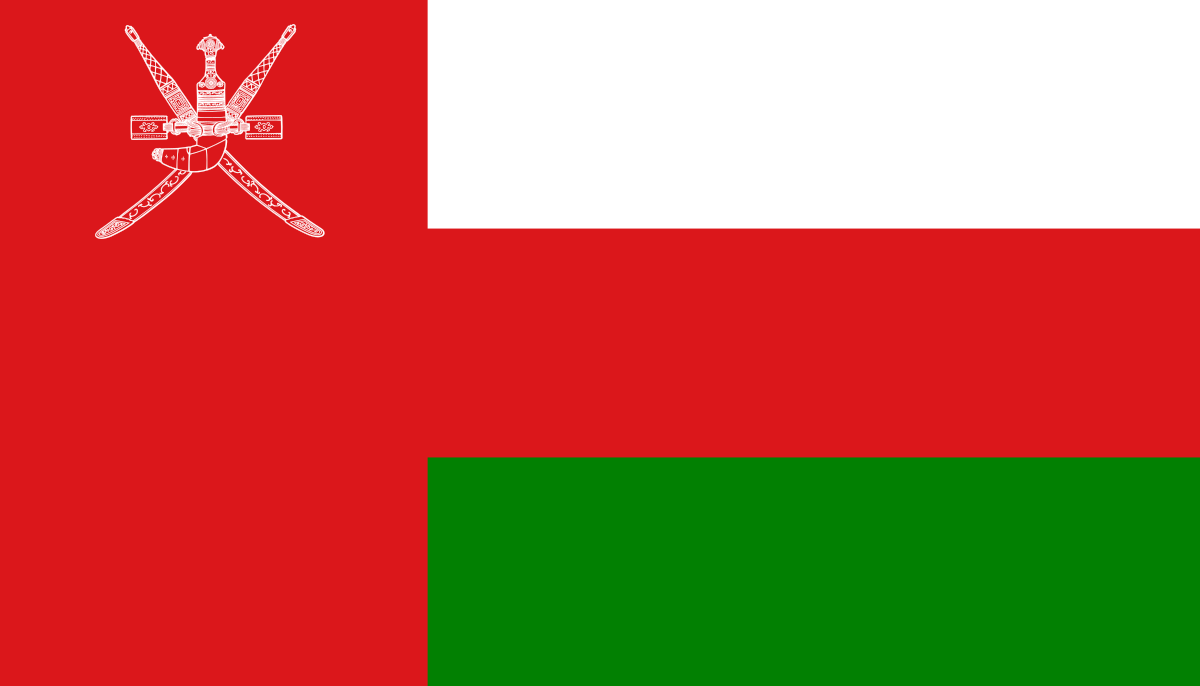
The official name of the country is the Sultanate of Oman. It covers an area of 309,500 km² (70th largest in the world). The population is approximately 8,143,800 (as of the end of 2025).
About 80% of Oman's population are Arabs. They are divided into two groups: Arab-Ariba ("pure Arabs"), which include the descendants of tribes that migrated from Yemen in ancient times, and Musta'Ariba ("mixed Arabs"). Indians, Baloch, and Persians also live in Oman's port cities.
Muslims constitute 85.9% of the total population, of which Omani citizens (56.4% of the total population) are: Ibadis - 45%; Sunnis - 45%; Shiites - 5%.
The official language is Arabic, but English and minority languages are also widely spoken.
The official currency of the country is the Omani rial.
Muscat is the capital and largest metropolitan area of Oman, as well as the seat of government. The city is the country's economic center due to its role in trade, servicing the major port of Sultan Qaboos, and the presence of a free zone for businesses.
Salalah is Oman's second-largest city and a major tourist destination. The city is the center of the Sultanate's perfume industry. The Salalah region is one of the country's main agricultural areas, but the soil here is not very fertile. Approximately 15 km southwest of the city, Oman's largest port, Salalah, was built in 1998 and enjoys a strategic location. A special economic zone was established around the port.
Sohar is the administrative center, located 240 km northwest of the capital, Muscat. The city is renowned for its maritime history. Traditionally, Sohar is a fishing center and is home to a large fish market (souk). Near Sohar are ancient copper mines and Jebel Akhdar (Green Mountain), the highest mountain in Oman. The historic cities of Ibri, Nakhl, Rustaq, and Nizwa are also nearby.
The city's economy is based on its port, in which several billion dollars have been invested. Sohar also boasts heavy industry, an oil refinery, an aluminum smelter, a petrochemical plant, and other industries.
Seeb (Al Seeb) is one of the largest cities in the country and an important commercial hub. Its economy relies on real estate, trade, and tourism, and it is an important residential and commercial center.
Oman is administratively divided into 11 governorates (mufazahs), comprising 61 districts (wilayats).
Scientists believe that the main route of human settlement from Africa to South and Southeast Asia passed through the territory of modern-day Oman. Locals believe that the tomb of the Islamic prophet Ayyub is located in Oman, in the city of Salalah.
The country's history is linked to another biblical figure—the Queen of Sheba, or Bilqis (as she is known in ancient Muslim legends). Three thousand years ago, the territory of the modern-day sultanate was part of the Sabaean Kingdom, which she ruled.
Until the 7th century, when Oman was incorporated into the Arab Caliphate and Islamized, the country remained a province of the Persian Empire for nearly 200 years. Until the early 16th century, Omani merchants traded with India and the Far East, becoming monopolists in the export of spices and incense to Europe. As a result, the sultanate became a prosperous state with developed crafts and culture.
In 1507, Portuguese rule arrived in the country with the fleet of Afonso de Albuquerque. The Portuguese burned all Arab ships in the ports and then plundered the coastal towns. The country's inhabitants only managed to free themselves from the European colonial power in 1650.
At the beginning of the 18th century, Oman was invaded by the Persians again, but they were expelled in 1741 by Ahmed Zafari. He created a pirate state that, along with Oman, included the islands of the Persian Gulf, the coast of Iran, and East Africa. From that time on, Oman has never again been a colony of any country.
In 1970, Sultan Qaboos bin Said came to power in Oman through a bloodless coup, overthrowing his father. Under his rule, education, medicine, industry, tourism, and many other sectors began to develop. The country is currently ruled by Sultan Heytham bin Tariq. The effective governance of the modern sultanate has enabled Oman to achieve prosperity and economic development.
Oman is located in Western Asia, in the southeast of the Arabian Peninsula. North of the mainland lies the small semi-exclave of Musandam and its full exclave, Madha (one of the Musandam vilayets), separated from the mainland by the United Arab Emirates. Besides the UAE, Oman's neighbors include Saudi Arabia and Yemen. The country's coastline is washed by the Arabian Sea, the Gulf of Oman, and the Persian Gulf.
Along the Gulf of Oman coast lies a green plain, giving way to the Hajar Mountains, while in the center and southeast lies a hilly mountainous region. To the west lies the Rub' al-Khali Desert, one of the largest and hottest in the world. The highest point above sea level in Oman is Mount Ash Sham, or Mountain of the Sun, at over 3,000 meters. There are no permanent rivers in Oman. All rivers have only intermittent flows, mainly in winter.
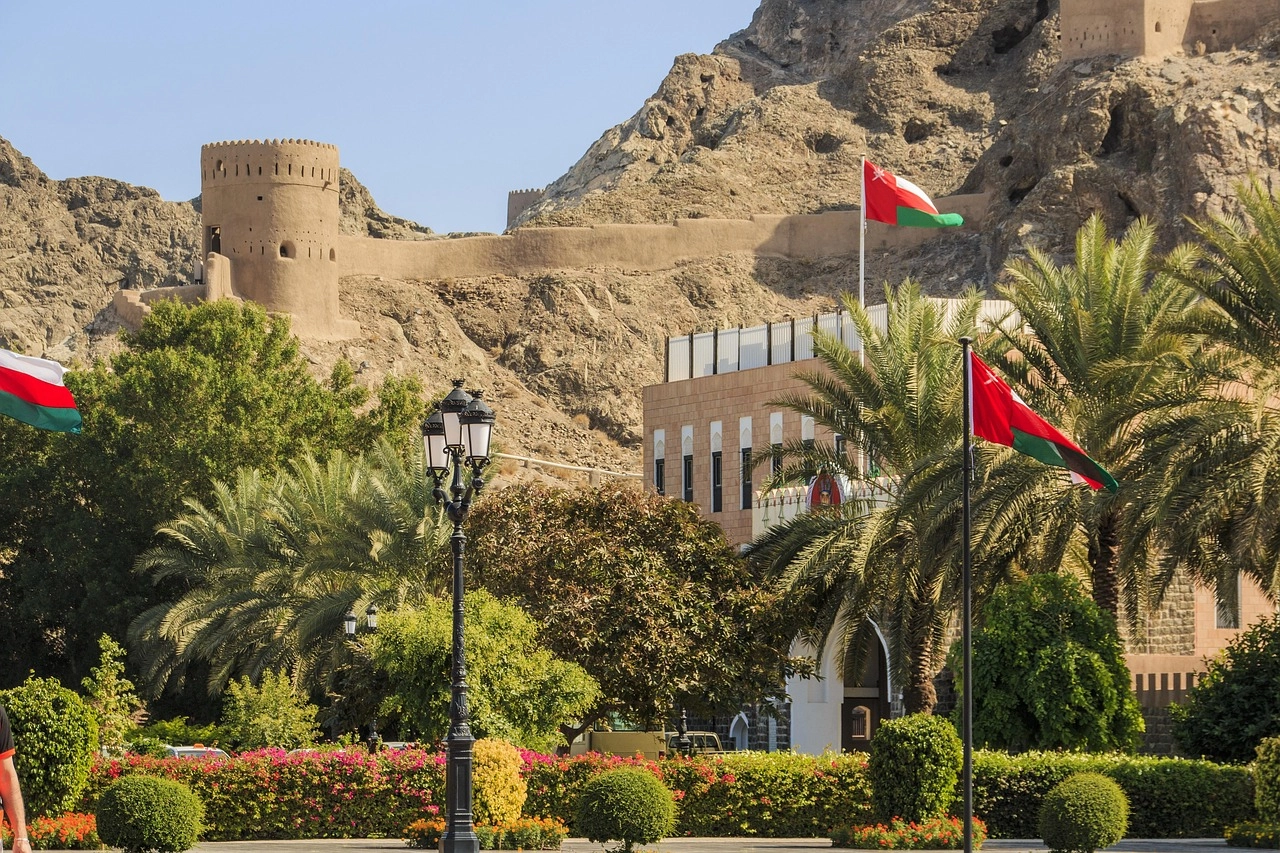
Omani culture is a fusion of Arab traditions. The country's architecture has unique features. Prominent examples of this achievement include the Qaboos Mosque, Al Alam Palace, and Mirani Fort (located in Muscat). The souks offer stunning handicrafts and traditional jewelry. Omani artisans are renowned for their jewelry. Oman also prides itself on its cultural events, where you can immerse yourself in the atmosphere of a true Arabian holiday.
A number of traditions have survived to this day. These include the trade in frankincense, a staple commodity during the early days of the Omani Empire; weekly bullfights that draw crowds of onlookers; and the gifting of a khanjar, an expensive decorative dagger. The khanjar is a purely Omani invention. It is believed that every Omani man should own at least one.
The most important tradition for every citizen of the country is respect for the Sultanate.
One of the main characteristics of Omani culture is modesty in dress. Revealing clothing should be avoided in public places; women are advised to cover their shoulders, knees, and hair, and men are advised not to wear shorts above the knee. Strict rules apply when visiting mosques: women must be fully covered, and men are prohibited from wearing shorts. Shoes must be removed before entering, and photography is strictly prohibited inside.
In Oman, it is customary to politely shake hands upon meeting, with men only shaking hands with men. Women are best greeted with a nod. Close hugs and kisses in public should be avoided, even between spouses; this is considered impolite. Kissing on the cheeks between men is also common when meeting close friends or relatives.
Eating at the table is customary only with the right hand; the left is considered "unclean." Elbows should not be placed on the table while eating. Omanis often eat with their hands, so it's a good idea to learn this tradition. It's important to wait for the eldest person at the table to begin eating first.
Omanis are very hospitable, but they also value modesty and restraint in interactions. Avoid asking overly personal questions or criticizing local customs. When taking photographs, it's best to ask permission.
The Sultanate of Oman is an absolute monarchy. The Sultan of Oman is not only the head of state, but also the head of government, commander-in-chief, minister of defense, foreign affairs, and finance. The Sultan also appoints the cabinet of ministers. The post of head of state is hereditary among members of the Al Said dynasty. Since 2020, the country has been ruled by Sultan Heitham bin Tariq.
The Sultan of Oman, Qaboos bin Said Al Bu Said, who reigned until 2020, wielded unlimited influence and power. In addition to his position as Sultan, he held the positions of Prime Minister, Minister of Defense, Minister of Finance, Minister of Foreign Affairs, and Governor of the Central Bank. Members of the Sultan's family have very limited political influence, holding only a few cabinet positions.
In November 1991, Sultan Qaboos formed the Consultative Assembly (Majlis al-Shura) to replace the State Advisory Council, established in 1981. The Majlis al-Shura was created to expand and systematize public participation in government. The Majlis al-Shura consists of 84 members who exercise some legislative powers. Each province nominates three candidates, whose candidacies are first reviewed by the Government Committee, after which the Sultan makes the final decision. The Majlis al-Shura serves as a liaison between the public and the ministries and is authorized to review draft economic and social legislation prepared by ministry departments and make recommendations.
The Majlis al-Shura does not have authority over matters of defense, security, finance, or foreign affairs.
Oman has a diverse and developed economy, supported by several key sectors that significantly contribute to economic growth and financial stability. The Sultanate has made significant strides in infrastructure, education, and healthcare, creating an attractive investment environment for local and international investors. In recent years, the Omani government has implemented prudent economic policies and structural reforms aimed at strengthening economic stability and diversifying revenue sources away from oil.
These reforms include improving the business climate, developing small and medium-sized enterprises (SMEs), encouraging foreign investment, and achieving economic integration with Gulf Cooperation Council (GCC) countries. The government is also focused on implementing Oman Vision 2040, which aims to promote sustainable development, innovation, and human capital development, stimulating economic growth and prosperity. Key elements of the Omani economy:
- Oil and Gas Sector
The oil and gas sector remains the cornerstone of Oman's economy, significantly contributing to government revenue and serving as a primary source of foreign exchange. This sector accounts for approximately 70% of government revenue and over 50% of the gross domestic product (GDP). The government is investing in modern technology and exploring new fields to increase production and reserves. Additionally, efforts are being made to develop the petrochemical industry to convert raw materials into high-value-added products, thereby diversifying revenue sources and increasing the added value of oil and gas production.
- Tourism Sector
Oman's tourism sector has demonstrated steady growth, positioning the country as a unique destination combining cultural heritage and natural beauty. The government is developing this sector by developing tourism infrastructure and offering incentives to investors. Tourism accounts for approximately 2.5% of GDP, with ambitions to increase this share to 6% by 2040. Oman, known for its historic forts, beautiful beaches, vast deserts, and the Green Mountain, attracts visitors from around the world. These efforts are aimed at diversifying the economy and creating new jobs for citizens.
- Industrial Sector
The industrial sector plays a vital role in diversifying Oman's economy. Key industries include chemicals, plastics, and metals, accounting for approximately 15% of GDP. The government is establishing new industrial zones and providing opportunities for foreign and local companies to launch their industrial projects. The Duqm Industrial Zone is a key initiative aimed at strengthening this sector and transforming it into a regional economic hub. Additionally, the government supports SMEs in this sector to foster innovation and improve productivity.
- Logistics Sector
Oman aims to become a major logistics hub in the region, leveraging its strategic location on global trade routes. The logistics sector accounts for approximately 5% of GDP, and the government plans to increase this share by developing transport infrastructure, ports, and airports to enhance the country's capabilities in this area.
The Port of Salalah and Port of Sohar are key logistics hubs, equipped with modern facilities and significant ship and cargo handling capacity. Development of this sector aims to attract foreign investment, in addition to increasing exports and imports, thereby promoting economic growth and creating new jobs.
Oman is expected to demonstrate sustainable economic growth in the coming years, thanks to government efforts to diversify revenue sources and implement major projects across various sectors. Foreign and local investment in non-oil sectors is expected to increase thanks to supportive policies and economic reforms. Economic growth is projected to range between 3% and 5% annually in the coming years. Major projects such as the Duqm Economic Zone, major tourism initiatives, and the expansion of transport and logistics infrastructure are significantly contributing to the economy and creating new jobs.
Furthermore, the government aims to improve the efficiency of public spending and increase non-oil revenues by developing promising sectors such as technology, manufacturing, and renewable energy. These positive forecasts enhance Oman's attractiveness as an investment destination and contribute to economic and social stability.
Russia and Oman
Diplomatic relations between the USSR and the Sultanate of Oman were established on September 26, 1985. In 1987, the Soviet embassy was opened in Muscat. In 1991, Oman officially recognized the Russian Federation as the legal successor to the Soviet Union.
Regular delegation exchanges are conducted between Russia and Oman through the governments of the two countries, public and private companies, and chambers of commerce and industry.
In 2024, Oman became a guest country at the St. Petersburg International Economic Forum.
The volume of mutual trade in goods has more than doubled over the past three years. In 2023, mutual investments between Russia and Oman will be Oman amounted to $90 million (according to the Russian Chamber of Commerce and Industry).
At the strategic session of the SPIEF-2024 "Russia - Oman" The Minister of Commerce, Industry, and Investment Promotion of the Sultanate of Oman and the Chairman of the Oman Chamber of Commerce and Industry noted five promising areas for cooperation between Russia and Oman:
- Trade cooperation (increasing trade volumes through complementary products, including agricultural, fisheries, and chemical products);
- Technological cooperation (in the oil and gas sector, geological exploration and production; energy-saving technologies, water purification);
- Tourism (resort, cultural and educational);
- Logistics (Oman's strategic location, extensive port infrastructure);
- Climate agenda (creating balanced and sustainable ecosystems to protect the environment and ensure the preservation of natural resources).
The Ministry of Commerce, Industry, and Investment Promotion (MOCIIP) strives to attract foreign investors and create an environment conducive to business creation and private sector development. It works closely with government agencies and businesses in Oman and abroad, providing them with a variety of support.
MOCIIP also offers a range of investor advisory services aimed at supporting foreign companies considering investing in Oman, tailored to their specific needs and key target sectors identified in the country's diversification program.
MOCIIP's Oman Business Platform business registration website allows companies to obtain a commercial registration certificate from MOCIIP. MOCIIP can process most registrations in approximately three to four business days; however, some commercial registration and licensing decisions may require approval from multiple ministries and take longer. The Oman Business Platform integrates multiple government agencies into a single portal and serves as a one-stop shop for Omani businesses.
Investing in Oman combines economic stability with a favorable geographic location connecting Asia, Africa, and Europe, providing an excellent platform for regional and international growth. The country has flexible legislation permitting foreign ownership, offers government incentives, and boasts a developed infrastructure, including modern ports and free economic zones. A safe living environment and high quality of life make Oman an ideal choice for long-term investment.
Advantages of Investing in Oman
- Strategic Location: Oman's geographic location provides easy access to the Gulf region, Africa, and Asia, facilitating trade and investment opportunities.
- Skilled Workforce: Oman has a well-educated and multilingual workforce, providing businesses with access to talent across a variety of sectors.
- Competitive Costs: Oman offers competitive operating costs, including low utility rates and affordable real estate, making it an attractive location for business.
- Favorable Regulatory Environment: Oman has implemented a number of reforms aimed at making it easier to do business, including streamlining licensing procedures and improving protections. Investors.
Investment Incentives
- 100% Foreign Ownership: Oman allows full foreign ownership in most sectors, making the country an attractive destination for international investors.
- Tax Incentives: Oman offers tax incentives for certain industries, such as mining and manufacturing, to encourage investment in these sectors.
- Free Zones: Oman has established several free zones that offer additional incentives and benefits to businesses operating within them.
Oman is actively developing its infrastructure to attract foreign investment and simplify doing business. Support is provided through government agencies, free zones, investment funds, and specialized centers.
- Ministry of Commerce, Industry, and Investment Promotion of Oman. The Ministry of Commerce, Industry, and Investment Promotion (MOCIIP) is the main government body responsible for registering and licensing companies, formulating investment policy, and supporting foreign investors through the Invest Easy digital system.
- Oman Investment Authority (OIA). Oman's sovereign investment fund. Responsible for managing state assets, attracting strategic investors, and co-financing large projects.
- Invest Oman - Investor Services Center. A one-stop shop for investor services. Provides one-stop shop support, assistance with registration, licensing, visas, and consultations on investment opportunities.
- Oman Investment & Export Development Agency. Agency for investment and export support. Agency functions: promoting Oman abroad, assisting exporters, organizing business meetings and B2B events, and providing industry research.
- Oman Chamber of Commerce & Industry (OCCI). Provides: foreign business support, partner search, legal consultations, business missions, certificates, and business reports.
- Riyada (Authority for (SME) Development in Oman). The Small and Medium Enterprise Development Authority provides grants and concessional loans, entrepreneurial training, and consulting for startups.
- Oman Development Bank (ODB). The state-owned development bank supports project financing in industry, tourism, agriculture, and innovation, provides preferential programs for SMEs, and supports new entrepreneurs.
- OMRAN Group (Oman Tourism Development Company). The state-owned tourism development company. It implements and supports tourism projects and attracts private investment in the tourism and hospitality industries.
- ASYAD Group (Oman Logistics Cluster). The state-owned logistics holding company. Its functions include developing logistics, ports, and transport infrastructure, partnering with the private sector, and supporting investment projects in logistics.
- Oman Vision 2040 Implementation Follow-up Unit. The body oversees the implementation of the national development strategy. It supports projects aligned with Vision 2040, collaborates with the private sector, and removes regulatory barriers.

100,207,496 ¥


Each country has its own laws and rules for investors and business buyers. How to get around all the obstacles? Read related articles “Investor Life Hacks”.
