


Turkmenistan


Turkmenistan is a state in Central Asia with significant natural resource and investment potential. The country enjoys a strategic geographic location connecting the regions of Central Asia, the Middle East, and Europe, making it an important transit hub for trade and transport routes.
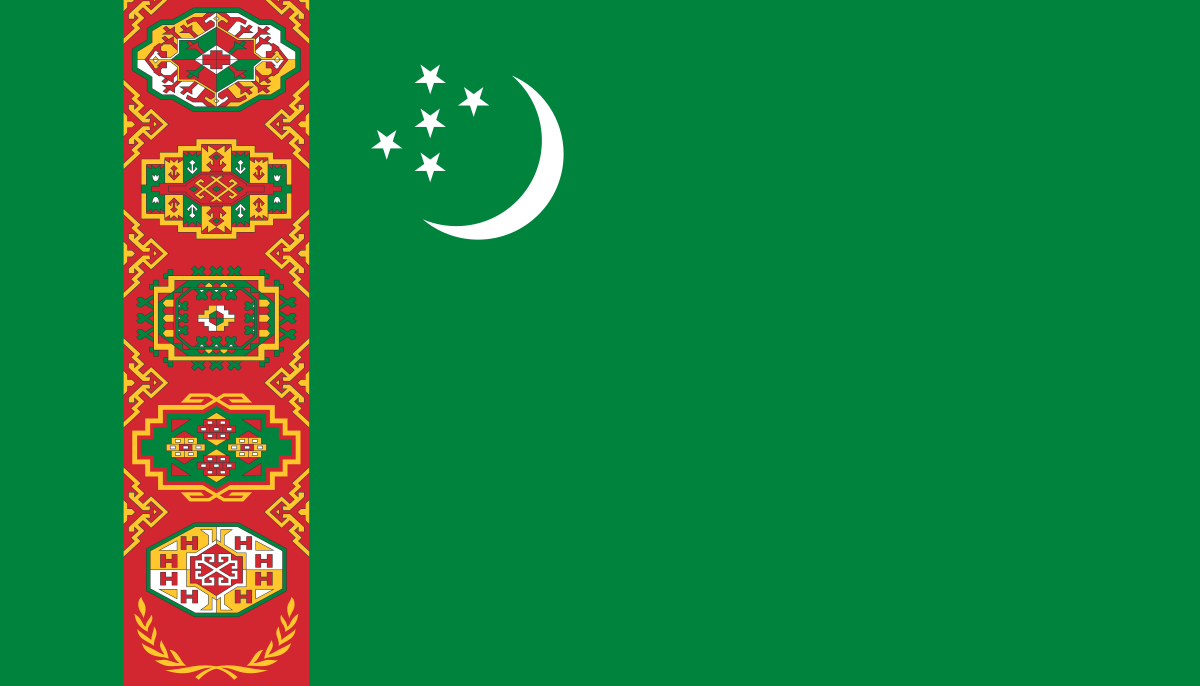
The official name of the country is Turkmenistan. It occupies an area of 491,200 km² (the 53rd largest in the world). The population is approximately 7.6 million (as of early 2025).
More than 40 ethnic groups reside in the country, of which approximately 90% are Turkmen. The majority of Turkmenistan's population is Muslim (primarily Sunni) – 90%, Christians – approximately 9%, and other faiths – 2%. The official language of Turkmenistan is Turkmen, the lingua franca is Russian, and English and Uzbek are also spoken.
The official currency is the manat.
Ashgabat is the capital and largest city of Turkmenistan, the country's main administrative, political, industrial, scientific, and cultural center. More than 43 large industrial facilities, 128 medium-sized enterprises, and over 1,700 small industrial enterprises are located in Ashgabat and its suburbs. The most important are Ashneftemash, Turkmenkabel, Turkmenbashi Textile Complex, and others.
Turkmenabat is the second largest city in Turkmenistan and its largest industrial center. It boasts auto repair plants, a cotton gin, a tannery, a chemical plant, a house-building plant, and a building materials plant. The city also boasts wool-washing, spinning and weaving, sewing, carpet, confectionery, and furniture factories, a brewery, and a dairy. Turkmenabat is the main center of the country's gas industry. The production of hand- and machine-woven carpets is a source of pride for city residents.
Dashoguz is the third largest city in Turkmenistan. The city boasts a cotton gin, oil expeller, textile, brewery, and dairy plant, as well as facilities for the repair of agricultural machinery, building materials, and reinforced concrete products. A meat-packing plant, a grain processing plant (Dashoguzgallaonumleri); carpet, garment, and confectionery factories.
Mary is the fourth largest city in modern Turkmenistan. Mary is home to a machine-building plant, an auto repair plant, a cotton gin, a tannery, a house-building plant, a building materials plant, the Turkmen Nitrogen Fertilizer Plant (TZAU), and a sugar refinery. The machine-building plant produces powerful centrifugal oil pumps, which are exported to various regions of the CIS and to more than 20 countries worldwide. The city also has a wool-washing plant, a spinning and weaving mill, a garment factory, a carpet factory, a confectionery factory, and a furniture factory, as well as a brewery and a dairy plant. Mary is the main center of the republic's gas industry. Located 19 km from the city is the Mary Hydroelectric Power Plant, Turkmenistan's largest hydroelectric power plant, with a capacity of 1,250,000 kW. It runs on gas from the Shatlyk field and generates over 80% of the country's electricity.
Turkmenbashi is a city in western Turkmenistan. It is home to a major international seaport, where shipbuilding and ship repair facilities are currently under construction. The city is the center of Turkmenistan's oil refining industry and is also home to the region's largest resort, Avaza.
The Turkmenbashi-Baku and Turkmenbashi-Astrakhan railway ferry services are an integral part of Turkmenistan's transportation system in international transport projects and corridors.
The administrative-territorial structure of the country is represented by five velayats, each of which is subdivided into etraps (37 etraps in total), six cities with etrap rights, as well as the city of Ashgabat with the rights of a velayat.
The history of Turkmenistan is the journey of a country situated at the crossroads of empires, trade routes, and civilizations. Ancient people inhabited the territory of modern Turkmenistan as early as 300,000 years ago, and the first agricultural settlements emerged here in the Neolithic era. Thanks to its advantageous location along the Silk Road, the region became one of the key centers of trade, culture, and statehood in Central Asia.
In ancient times, the lands of Turkmenistan were within the sphere of influence of the Achaemenid Empire and were later conquered by Alexander the Great. After the collapse of his empire, the powerful Parthian Empire arose here, with its capital in Nyssa (near modern-day Ashgabat). The Parthians transformed the region into a major economic and cultural center, developing trade, agriculture, and coinage.
In the Middle Ages, Turkmenistan became the core of the Seljuk and Khorezmshah states. The Seljuks created one of the largest Turkic empires of their time, extending their influence from Central Asia to the Middle East and Anatolia. The cities of Merv and Gurganj became intellectual centers of the Islamic world, where science, architecture, and literature flourished.
In the 13th century, the region experienced the devastating Mongol invasion of Genghis Khan. Cities, libraries, and irrigation systems were destroyed, and a significant portion of the population perished. Later, the lands of Turkmenistan were part of the Timurid states, the Khanate of Khiva, and Persia, remaining an arena for struggle between major powers.
Following the Battle of Geoktepe in 1881, Turkmenistan became part of the Russian Empire, and later the USSR. During the Soviet period, the country underwent industrialization, collectivization, and large-scale development of the oil and gas industry.
On October 27, 1991, Turkmenistan declared independence. In 1992, the country joined the United Nations, and in 1995, it received internationally recognized status of permanent neutrality. Today, Turkmenistan positions itself as an energy-rich Central Asian state, drawing on its vast natural gas reserves, strategic geographic location, and centuries-old historical heritage.
Turkmenistan borders Kazakhstan to the north, Uzbekistan to the east and northeast, Afghanistan to the southeast, and Iran to the south. To the west, it is washed by the Caspian Sea (it shares maritime borders with Russia, Iran, and Azerbaijan), while the Amu Darya River forms the country's northeastern border. To the south and southwest, Turkmenistan is surrounded by the Kopetdag and Parapamiz mountains. Approximately 80% of the country's area (375,000 km2) is covered by the sands of the Karakum Desert. The country's largest river is the Amu Darya (1,415 km long). The highest point of the Kopetdag mountain range is located near Ashgabat, at 2,912 meters above sea level.
Turkmenistan's subsoil contains valuable minerals: oil and natural gas, sulfur, lead, mirabilite, iodine, and bromine. It also has a variety of raw materials for the finishing industry: limestone, marl, dolomite, granite, gypsum, refractory clays, quartz sand, gravel, and pebbles. Industries such as oil production and fishing are closely linked to the Caspian Sea's natural resources.
Turkmenistan's culture has evolved over thousands of years, influenced by nomadic traditions, Islamic civilization, and the Great Silk Road. The main symbols of Turkmen culture are carpet weaving, jewelry, music, and monumental architecture. Turkmen carpets are considered a national treasure and are known for their intricate designs and handcrafted craftsmanship. The ancient cities of Merv and Kunya-Urgench, the Seljuk-era mausoleums, and the white marble style of modern Ashgabat occupy a special place in architecture.
Turkmen art is closely linked to folk epics, poetry, and music. The poet Magtymguly Pyragy, whose works are considered the spiritual foundation of national identity, has had a profound influence on the culture. Traditional music is performed on the national instrument, the dutar, and is accompanied by epic tales of honor, love, and freedom.
The Turkmen mentality is based on respect for family, elders, and traditions. Hospitality, restraint, a sense of dignity, and strong tribal solidarity characterize society. Turkmens value independence, keeping their word, and a respectful attitude toward the history of their people. Communication is often calm, tactful, and cautious, while personal trust and reputation play an important role in both everyday life and business relationships.
Turkmenistan is a presidential republic. The highest official, head of state, and head of executive power is the President. He or she is elected by direct, secret popular vote for a five-year term (there is no limit on the number of presidential terms).
The Khalk Maslakhaty (People's Council) is the country's highest representative body. Its powers include approving amendments to the Constitution of Turkmenistan, foreign and domestic policy, and approving national development programs and addressing security issues. Along with the head of state, members of parliament, the Cabinet of Ministers, and the Supreme Court, the Khalk Maslakhaty has the right to initiate legislation.
The legislative body is the unicameral Mejlis (since January 2023). It consists of 125 deputies elected by direct, secret popular vote. The term of office is five years.
The executive and administrative body is the Cabinet of Ministers, which includes the deputy chairmen of the Cabinet of Ministers and ministers. The Chairman is the President of Turkmenistan.
Judicial power is exercised by the Supreme Court of Turkmenistan and other courts as provided by law.
Turkmenistan's economy is built around its strategic advantage (the world's largest natural gas reserves), its advantageous geographic location between Asia and Europe, and its policy of state control over key sectors. Over the past decades, the country has consistently transformed from a predominantly agrarian republic into an industrial and energy hub of Central Asia.
The oil and gas sector forms the backbone of the country's economy. Turkmenistan is among the world's leaders in natural gas reserves, and the Galkynysh field is considered one of the largest on the planet. The country is focusing not only on raw material exports but also on the development of deep hydrocarbon processing—from gas chemicals to the production of polymers, methanol, and synthetic materials. Diversification of export routes remains a key objective, including the development of the TAPI (Turkmenistan–Afghanistan–Pakistan–India) gas pipeline project, which is considered one of the most important energy projects in the region.
The electric power industry is also developing. Turkmenistan's power grid is integrated with the Central Asian energy infrastructure and enables electricity exports to neighboring countries, including Afghanistan, Iran, and Turkey. The country is building new power plants, modernizing transmission lines, and expanding generation capacity.
Industry remains one of the fastest-growing sectors of the economy. In addition to petrochemicals, the state is actively investing in the chemical industry, construction materials production, mechanical engineering, and metalworking. Modern gas-chemical complexes are being built in the country, focused on producing high-value-added products, which should reduce the economy's dependence on raw material exports.
Particular attention is being paid to transport and logistics infrastructure. Situated between the Caspian region, China, Russia, South Asia, and the Middle East, Turkmenistan aims to become a key transit hub for Eurasia. The country is developing railways, highway corridors, seaports, and a pipeline system, strengthening the North-South and East-West routes. The authorities view the transport sector as the foundation for future regional integration and growth of the non-resource economy.
Agriculture remains an important part of the country's economic model. Turkmenistan has achieved a high degree of food self-sufficiency and is actively developing the production of cotton, grain, vegetables, and livestock products. At the same time, the government is focusing on modernizing the agro-industrial complex and expanding processing capacity.
The textile industry has become a distinct export sector. Since independence, more than 60 modern textile factories using local cotton have been built in the country. Turkmen textile products are exported to the European Union, the United States, China, Turkey, and other countries, and the industry is gradually becoming a driver of non-resource exports.
Turkmenistan's economic strategy is built around the idea of diversification: the authorities strive to simultaneously strengthen the energy sector, develop industrial processing, increase exports, modernize infrastructure, and attract foreign investment. The country actively cooperates with the International Monetary Fund, the World Bank, the European Bank for Reconstruction and Development, and the Asian Development Bank, while simultaneously maintaining its own model of economic governance with a high role for the state in strategic sectors.
Russia and Turkmenistan
Diplomatic relations between the Russian Federation and Turkmenistan were established on April 8, 1992. The legal framework for bilateral cooperation consists of over 200 interstate and intergovernmental agreements. In 2017, the Presidents signed the Treaty on Strategic Partnership between the Russian Federation and Turkmenistan, and in 2022, the Declaration on Deepening Strategic Partnership. Trade and economic cooperation between Russia and Turkmenistan is based on the provisions of the intergovernmental agreements on free trade of November 11, 1992, and on trade and economic cooperation of August 30, 2008.
Russia is Turkmenistan's main trading partner. Russian exports to Turkmenistan primarily consist of food products and agricultural raw materials (approximately 40%), metals and metal products (20%), chemical products (18%), machinery, equipment, and vehicles (14%), and timber, pulp, and paper products (6%).
Turkmenistan supplies textiles, textile products, and footwear (20%), food products and agricultural raw materials (15%), and chemical products (10%) to the Russian market.
The Agreement between the Government of the Russian Federation and the Government of Turkmenistan on the Promotion and Mutual Protection of Investments is the core document of Russian-Turkmen investment cooperation.
Approximately 190 economic entities with Russian capital operate in Turkmenistan, including representative offices and branches of major companies such as Gazprom PJSC, Kamaz PJSC, Vozrozhdenie JSC, Tatneft PJSC, Pipe Metallurgical Company PJSC, KER-Holding Management Company LLC, Russian Railways OJSC, Shchelkovo Agrokhim JSC, as well as representatives of Zarubezhgeologiya JSC, Gazstroyprom JSC, Informtekhnika i Svyaz Group of Companies JSC, Ural Automobile Plant JSC, and Ural Steel Management Company LLC.
The institutional framework for foreign economic cooperation is the Intergovernmental Russian-Turkmen Commission on Economic Cooperation (IPC), which examines prospects for cooperation in trade, transport, banking, energy, industry and agriculture, education and science, healthcare, culture, and sports. The Commission has established a High-Level Group for Trade and Investment Support, whose activities are aimed at resolving bilateral issues and identifying mutual interests in implementing joint infrastructure projects.
In 2025, numerous contacts between government agencies and businesses, held both at congress venues and at the Russian Federation Trade Mission in Turkmenistan, facilitated the development of foreign economic cooperation in trade, transport, agriculture, and industry, as well as cooperation in education, healthcare, culture, tourism, and sports.
Russia and Turkmenistan are also exploring prospects for trade and economic cooperation in the fuel and energy, chemical, construction, and digital technologies sectors. In addition, positive dynamics in freight traffic along the eastern chord of the North-South International Transport Corridor (ITC) have been recorded, as well as the need for further development of the multimodal corridor, including its maritime route.
Turkmenistan's business climate is shaped by predominantly state regulation of the economy, with a gradually expanding role for the private sector. The business management system remains centralized, but in recent years, steps have been taken to simplify administrative procedures and make entrepreneurial activity more accessible.
One of the key features of the business environment is the active participation of the state in the economy and strategic sectors. This is reflected in the regulation of key markets, the participation of government agencies in major projects, and the significant role of state-owned enterprises in industry and infrastructure. At the same time, private entrepreneurship is gradually strengthening its position, particularly in trade, construction, services, and agricultural processing.
The regulatory environment is characterized by the relative predictability of administrative procedures. In recent years, measures have been taken to streamline business registration, reduce bureaucratic barriers, and reduce the time required to obtain permits. This facilitates the rapid launch of new companies and projects, particularly in the small and medium-sized business segment.
The country's financial system remains bank-oriented, with limited development of alternative sources of financing. State-owned and large commercial banks play a primary role in business lending. Access to capital largely depends on administrative procedures and industry priorities, which influence the structure of entrepreneurial activity.
The foreign economic dimension of the business environment is particularly important. Export-import transactions are regulated through specialized government agencies and the banking system, creating a fairly formalized model of international trade. At the same time, the development of transport corridors and logistics infrastructure is gradually expanding opportunities for foreign economic interaction.
The institutional framework of the business environment is complemented by business associations and industry unions, which act as intermediaries between entrepreneurs and the government and facilitate the development of business ties and the participation of companies in industry initiatives.
Overall, Turkmenistan's business climate can be characterized as a structured and state-oriented system, in which elements of liberalization and support for the private sector are gradually strengthening, although key economic decisions remain concentrated at the state level.
Turkmenistan has significant potential to attract foreign direct investment due to its abundant natural resources, strategic geographic location, and gradual economic modernization. The energy sector is a key focus for investors.
In recent years, the government has been actively promoting economic diversification policies. Particular attention has been paid to the development of the gas chemical industry, agriculture, textile manufacturing, construction, and transport infrastructure. These measures are aimed at reducing dependence on raw material exports and increasing the share of high-value-added products.
Investment activity in the country is gradually growing. Investments in the Turkmen economy exceed $10 billion, with a significant portion directed toward the real sector. Domestic private sector investment accounts for over 50%, while foreign investment accounts for approximately 11-12% of the total. This reflects the continued role of the state in the economy while entrepreneurial activity is growing.
A stable tax system is an important factor in investment attractiveness. Tax rates have remained relatively low and predictable for a long time, creating a stable fiscal environment for businesses. This is especially important for long-term investment projects.
To improve the business climate, institutional reforms are being implemented in the country. The legal entity registration process has been simplified, the business registration period has been reduced from 14 to 3 days, the number of required documents has been reduced, and the list of licensed activities has been optimized. Customs procedures are also being streamlined, facilitating foreign economic activity.
Infrastructure projects play a key role in Turkmenistan's economy. The development of the Turkmenbashi International Seaport, transport corridors, and railway routes strengthens the country's transit potential and increases its importance in regional trade between Europe and Asia.
Energy, agriculture, textiles, construction, and tourism remain promising areas for investment. The government is implementing a long-term socioeconomic development program through 2052, aimed at modernizing the economy, introducing new technologies, and increasing sustainable growth.
Overall, Turkmenistan's investment climate is characterized by a combination of significant resource potential, a stable macroeconomic base, and a gradually improving regulatory environment, while maintaining a high role for the state in the economy.
Turkmenistan also has a number of government and public structures that support businesses, attract investment, and develop entrepreneurship. The main ones are:
- Ministry of Finance and Economy of Turkmenistan
This body formulates and implements the country's economic policy, develops measures to improve the investment climate, supports state business development programs, and monitors macroeconomic stability.
- Central Bank of Turkmenistan
Responsible for monetary policy, regulation of the banking sector, and ensuring the stability of the national financial system.
- State Bank for Foreign Economic Activity of Turkmenistan
Specializes in servicing foreign trade operations, supporting exporters, and financing international economic projects.
- Chamber of Commerce and Industry of Turkmenistan
Represents the interests of businesses, promotes the development of business ties, and organizes Exhibitions, forums, and business missions, and helps entrepreneurs enter international markets.
- Union of Industrialists and Entrepreneurs of Turkmenistan
A key public organization uniting private businesses. It supports the development of entrepreneurship, offers consultations, helps establish business contacts, and participates in dialogue with the government.
- Ministry of Trade and Foreign Economic Relations of Turkmenistan
Regulates foreign trade, develops export potential, and attracts foreign partners.
- Industry Unions and Professional Associations
The country also has specialized associations of entrepreneurs by economic sector (construction, agro-industrial complex, textile industry, etc.). They facilitate the exchange of experience, the implementation of new technologies, and the protection of company interests within specific industries.
Overall, the Turkmen government actively participates in regulating the economy and stimulating investment, with banks, relevant ministries, and business associations playing a significant role in creating the infrastructure for the development of entrepreneurship and international cooperation.

32,122,046 ¥
4,684,465 ¥
26,099,163 ¥


Want to compare several objects in the catalog to choose the best one? Add it to "Comparisons". To do this, click the scale icon in the upper right corner of the card or ad page. In each section of the catalog, you can create a comparison list of up to 5 lots.

