


Sale of businesses in Russia by owners from "unfriendly" countries: specifics and outlook for 2027
 Table of contents

Since 2022, the Russian business landscape has undergone significant change. For foreign investors — particularly those from countries designated by Russia as "unfriendly" — both holding Russian assets and divesting from them have become more complex processes. The terms for executing transactions have shifted, new restrictions have been introduced, and in many cases, the pool of potential buyers has narrowed.
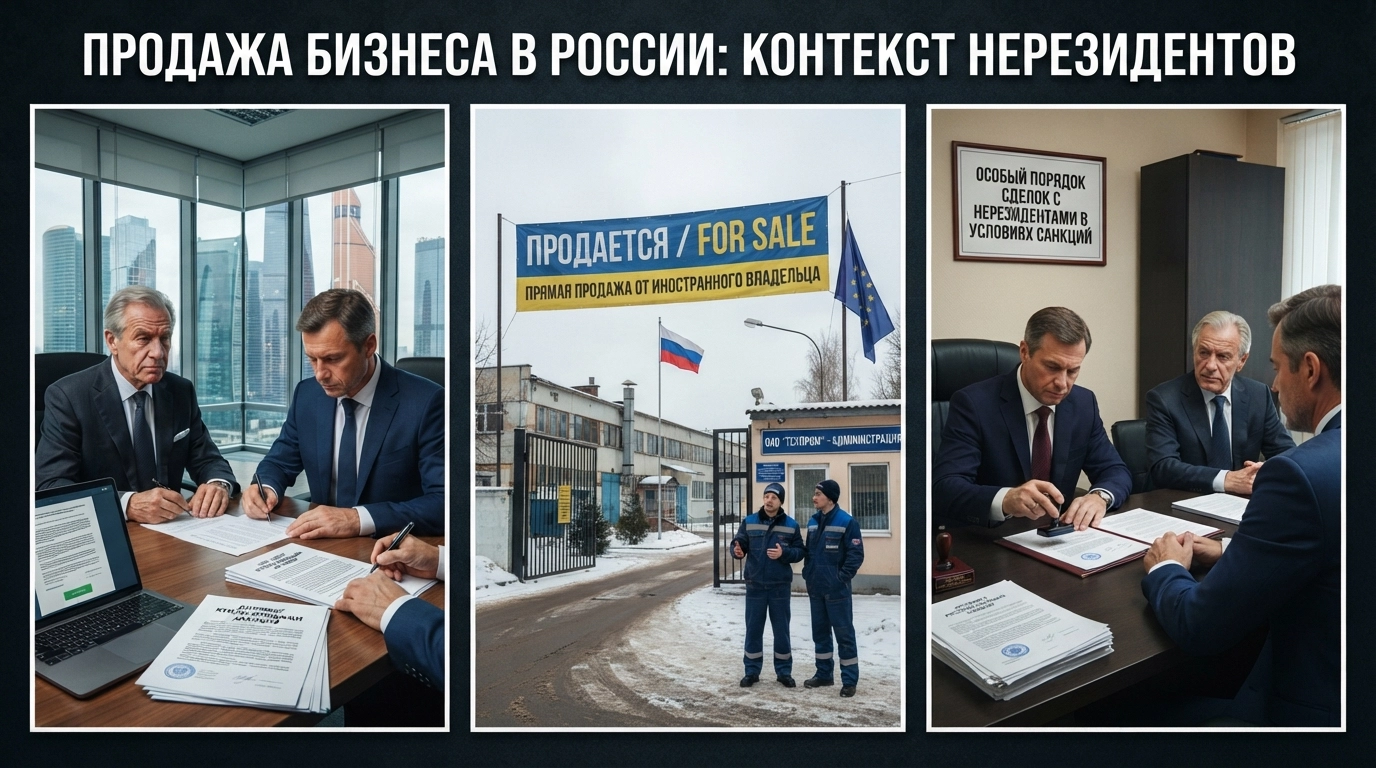
Despite this, foreign owners continue to show interest in selling Russian companies. Some owners are considering a complete exit from the Russian business, while others want to sell part of their assets, bring in a new partner, or change the ownership structure. The reasons may vary: a change in the company's international strategy, difficulties in managing assets from abroad, restrictions on financial settlements, or a desire to reallocate capital.
This issue is particularly relevant for owners of medium and large businesses valued at \$1 million or more. Selling such an asset requires not only finding an interested investor but also thorough preparation of the company itself. It is important for the buyer to understand the financial condition of the business, its ownership structure, the composition of its assets, its obligations, and any possible restrictions on the transfer of ownership rights.
The main feature of the current situation is that the sale of a business by a foreign owner from an unfriendly country does not always follow the standard scenario. For certain transactions, Russian legislation provides for special requirements, approvals, and restrictions. These vary depending on the company's legal form, the industry, the composition of the owners, and the nature of the assets being transferred.
Therefore, there is no universal solution for all foreign owners. In some cases, a sale may be organized with due consideration of the established approval procedure, while in others, an additional legal assessment or the search for an alternative transaction structure may be required. It is important to take these circumstances into account even before negotiations with potential buyers begin.
In this article, we will examine which legislative restrictions affect the sale of Russian businesses by owners from unfriendly countries, how they are reflected in the value and timing of transactions, and which factors should be considered when planning an exit from an asset in 2027.
Who Is Classified as an Owner from an Unfriendly Country
The basic list of foreign states and territories taking unfriendly actions against Russia, Russian legal entities, and individuals was approved by Decree No. 430-r of the Government of the Russian Federation dated March 5, 2022.
The list includes the following states and territories:
- European Union: all EU member states, including Germany, France, Italy, Spain, the Netherlands, Austria, Poland, the Czech Republic, Cyprus, and other countries.
- North America: the United States and Canada.
- European states outside the EU: the United Kingdom, Norway, Switzerland, Iceland, Liechtenstein, Monaco, San Marino, Albania, Andorra, Montenegro, and North Macedonia.
- Asia-Pacific region: Japan, the Republic of Korea, Australia, New Zealand, Singapore, Micronesia, and Taiwan (China).
- Caribbean Basin: the Bahamas (added to the list by Decree No. 2018-r of the Government of the Russian Federation dated July 23, 2022).
- Other territories: Ukraine, as well as the Crown dependencies of the British Crown and the British Overseas Territories. Certain such territories were included in the original version of the list; however, Decree No. 3216-r of the Government of the Russian Federation dated October 29, 2022, broadened the wording: it now covers all Crown dependencies and all British Overseas Territories (including Bermuda, the Cayman Islands, the British Virgin Islands, Gibraltar, Jersey, Guernsey, the Isle of Man, and others).
The list is important as a starting point, but by itself it does not provide a definitive answer regarding the applicability of a specific restriction. The presidential decrees use additional criteria: the citizenship of individuals, the place of registration of foreign organizations, the place of their predominant business activity or profit generation, as well as the existence of control over them.
Therefore, when analyzing a transaction, it is not enough to check only the immediate participant in the Russian company. For example, a Russian company may be owned by a holding registered in the UAE or another jurisdiction not included in the list. However, if the ultimate controlling owner is connected with an unfriendly state, the registration of an intermediate company in a third country by itself does not guarantee that the restrictions will not apply.
It is also important not to confuse the Russian list No. 430-r with the sanctions lists of the United States, the EU, the United Kingdom, and other states. These are different legal instruments: inclusion on a foreign sanctions list and classification as a person connected with an unfriendly state are not identical criteria.
When determining the owner's status, it is important to take into account not only the country of the company's registration. The citizenship of the ultimate owner, the control structure, and the presence of persons connected with unfriendly states may also matter.
Therefore, the registration of a holding company in a third country by itself does not guarantee that the transaction will be considered outside the special restrictions. In certain cases, consideration is given to who actually controls the company and makes decisions.
In November 2026, Decree of the President of the Russian Federation No. 816 introduced amendments to a number of previously adopted decrees. In particular, the rules for determining the status of certain individuals were clarified for cases where they did not submit documents confirming Russian citizenship, or citizenship or permanent residence in a state not classified as unfriendly. The applicability of these provisions depends on the specific decree and the circumstances of the transaction.
Which Legislative Restrictions Are in Effect
Several special decrees of the President of the Russian Federation apply to transactions involving owners from unfriendly countries. They regulate different types of operations, so it cannot be assumed that the same procedure applies to any sale of a business.
- Decree No. 81 dated March 1, 2022, establishes a special procedure for a number of operations involving persons connected with unfriendly states. In particular, it concerns certain transactions with securities and real estate. This is not a universal requirement to obtain permission for any sale of a company.
- Decree No. 520 dated August 5, 2022, restricts certain transactions with securities, shares, and rights with respect to the Russian companies and assets provided for therein. Primarily, this concerns certain organizations of strategic importance, as well as companies in certain financial and energy sectors. For the cases provided for, special approval mechanisms exist. The period of validity of the restrictions established by the decree is until December 31, 2027, inclusive.
- Decree No. 618 dated September 8, 2022, regulates certain transactions with shares in Russian limited liability companies. In cases falling under its scope, permission from the Government Commission is required.
- Decree No. 737 dated October 15, 2022, extends special rules to certain transactions with shares of Russian joint-stock companies. For a number of financial organizations, separate requirements are provided in the event of changes in ownership shares and votes exceeding 1%. This threshold does not apply to all Russian companies.
There are also other documents that may affect the relationship of a foreign owner with a Russian business:
- Decree No. 95 regulates the performance of certain monetary obligations toward foreign creditors from unfriendly states.
- Decree No. 254 concerns the payment of profits to certain foreign participants of Russian companies.
These two decrees do not establish the primary procedure for the sale of a business, but they may be relevant in settlements with the owner, the payment of dividends, and the performance of obligations.
- Decree No. 816 dated November 5, 2026, introduced amendments to a number of previously adopted presidential decrees, including Nos. 81, 95, 254, 618, and 737. Therefore, when preparing a transaction, it is important to check the current version of the legislation rather than relying only on the original rules.
Main point: the need for approvals and the possibility of a sale are determined on a case-by-case basis. The type of company, the ownership structure, the industry, the composition of assets, and the specific conditions of the transaction all matter.
How Restrictions Affect the Sale of a Business
For owners from unfriendly countries, the restrictions may affect several key parameters of the transaction.
- The pool of buyers. Not every investor is ready to acquire a business if the transaction involves additional approvals and uncertainty regarding timing. Therefore, finding a suitable buyer may take more time.
- The timing of the sale. In addition to the standard review of the company's finances and assets, a legal examination and the obtaining of necessary approvals may be required. It is impossible to determine a uniform timeline for such transactions in advance.
- The value of the business. The buyer assesses not only the company's profits and assets but also the risks associated with executing the transaction, settlements, and further ownership. This may affect the offered price. However, there is no uniform mandatory discount for all foreign owners.
- The structure of the transaction. The sale of shares, equity stakes, or individual assets entails different legal consequences. Selling the property instead of the company is not a universal way to circumvent the restrictions: certain operations with assets may also fall under special rules.
What to Expect in 2027
In 2027, some foreign owners will likely continue to consider selling Russian assets. For some, this will be a way to completely exit the market; for others, an opportunity to bring in a new partner or change the ownership structure.
At the same time, one should not count on the automatic repeal of all restrictions. For example, the period of validity of the restrictions established by Decree No. 520 is set until the end of 2027. But this does not mean that the other special rules will cease to apply at the same time.
For business owners, this means that the decision to sell is best prepared in advance. It is necessary to assess the value of the company, identify the potential pool of buyers, prepare financial information, and verify the legal conditions for exiting the asset.
How to Prepare a Business for Sale
Even under restrictive conditions, quality preparation increases the chances of successful negotiations. It is advisable for the owner to do the following in advance:
- put the financial and management reporting in order;
- prepare information about the company, its assets, obligations, and key contracts;
- determine the market value of the business;
- assess the potential pool of buyers;
- verify the ownership structure and applicable restrictions;
- determine, together with specialized lawyers, a possible procedure for conducting the transaction.
It is important not to postpone the legal due diligence until the moment when a buyer has already been found. A preliminary assessment makes it possible to understand which sale options are available and not to waste time on negotiations over a transaction structure that is clearly unsuitable.
How REAB Can Help
REAB helps owners prepare a Russian business for sale, assess its commercial prospects, determine its positioning, prepare materials for investors, find potential buyers, and organize the negotiation process.
For foreign owners, it is especially important to start this work in advance. This makes it possible to take the restrictions into account already at the stage of strategy formation, rather than after preliminary agreements with an investor have been reached.
REAB, with the involvement of specialized specialists, helps prepare the transaction for review by the Government Commission and then supports it through to closing. However, we would like to point out: the granting of permission or a positive decision by a government body cannot be guaranteed.
So, the sale of a Russian business by an owner from an unfriendly country remains possible but requires more thorough preparation. The conditions for exiting depend on the ownership structure, the industry, the composition of assets, and the applicable legislative restrictions.
For owners of businesses valued at more than $1 million, the key task is not simply to find a buyer, but to determine a realistic sale scenario in advance and to assess the timeline and possible value of the transaction.
In 2027, competent preparation of the asset, an understanding of legislative requirements, and the professional organization of negotiations will remain important conditions for a successful exit from the Russian business.

 Telegram
 VK.com
 Facebook
 X (Twitter)
 LinkedIn
 Other topics:
 REAB Services
Initial business valuation
Business analysis and audit (Due Diligence)
Business pre-sale preparation
Initial assessment of the business being purchased
Audit of the purchased business (Due Diligence)
Company Registration — General Provisions

 News
 Useful tip
Interested in an ad in the catalog? To avoid losing it and easily find it in the future, add it to "Favorites". To do this, click the heart icon in the upper right corner of the card or ad page.
