


Liberia
 Table of contents

Liberia is one of the most promising, yet underexplored, destinations for international business in West Africa. Situated on the Atlantic coast, the country possesses significant reserves of iron ore, gold, diamonds, timber, and rubber, and occupies a strategic location at the intersection of important maritime trade routes.
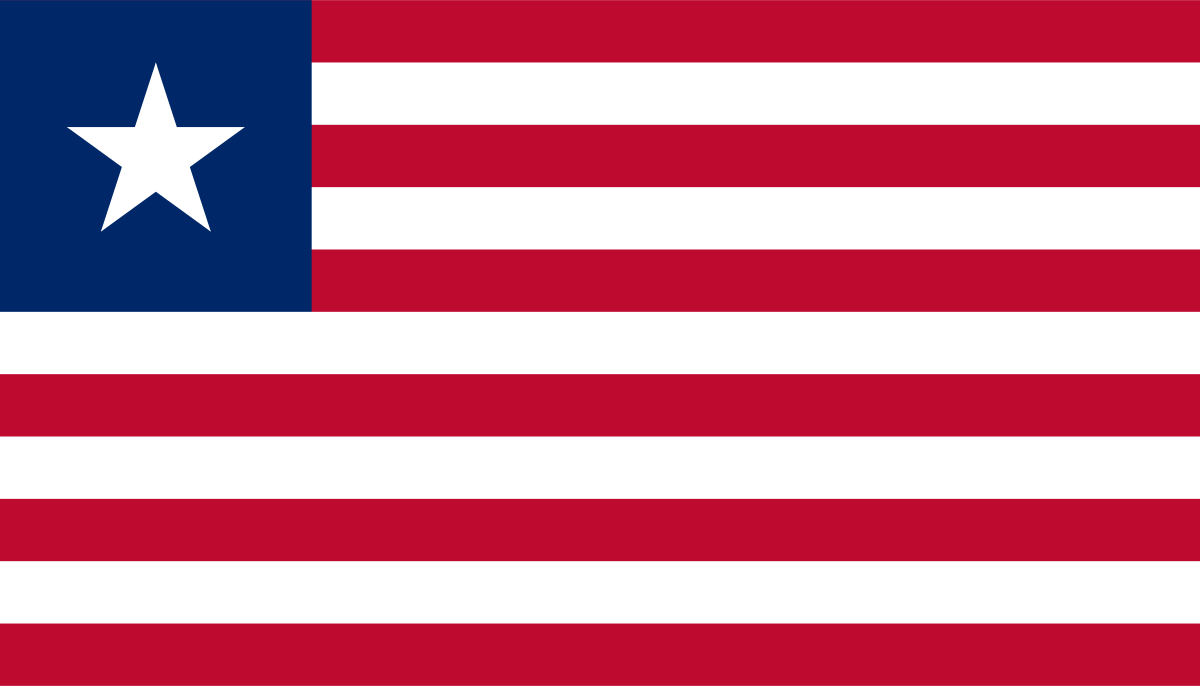
General information
The official name of the country is the Republic of Liberia. It occupies an area of 111,369 km² (102nd largest in the world). The population is approximately 5,853,950 (as of 2026).
The country's population can be divided into three groups: indigenous ethnic groups, Americo-Liberians (who immigrated from the United States, the Caribbean, and South America), and immigrants from neighboring African countries.
Approximately 85% of the population is Christian (including Afro-Christian syncretic movements), and 12% is Muslim. There are also representatives of Buddhism, Hinduism, Sikhism, and indigenous religious cults.
English is the country's official language (spoken by approximately 20% of the population). The majority of Liberia's indigenous population (96.3%) speaks Niger-Congo languages.
The country's official currency is the Liberian dollar.
Monrovia is the largest city and capital of Liberia. It is the second capital in the world (other than Washington, D.C.) named after an American president.
Monrovia is also the only duty-free port in West Africa. The city derives significant income from the transit of goods to neighboring countries. Cargo turnover is approximately 12 million tons per year. The food, petrochemical, pharmaceutical, cement, and fishing industries are well-developed.
Administratively, the country is divided into 15 counties, which in turn are divided into 53 districts.
History, geography, culture, mentality
The history of Liberia's statehood begins with the arrival of the first African-American settlers. In 1821, the American Colonization Society purchased land on Cape Mesurado from local chieftains for the resettlement of freed American slaves. The territory they settled was named Liberia (from the Latin "liber" meaning "free").
In 1834-36, the first settlements emerged here: Maryland, Bassa Cove, and Mississippi, which united to form the Commonwealth of Liberian Settlements. Following a referendum held among the population of the Commonwealth, the independent Republic of Liberia was proclaimed on July 26, 1847. In 1911, Liberia, with the support of the United States, achieved final international recognition of its borders.
Historically, American immigrants—the so-called Americo-Liberians—have played a leading role in Liberia's political and economic life (approximately 10% of the population), owning key businesses and companies. In 1869, they formed the True Whig Party, which held power in the country from 1878 to 1980.
In 1980, a military coup organized by Staff Sergeant Stanley Doe overthrew the government of William Tolbert and established an authoritarian regime. In December 1989, the National Patriotic Front of Liberia, led by Charles Taylor, launched an armed struggle against Doe. The country was engulfed in its first civil war (1989-1996), and a second one in 1998, ending on August 18, 2003, with the signing of a peace agreement in Accra. In September 2003, a UN peacekeeping contingent was deployed to Liberia to implement the ceasefire agreement, but it only left the country in 2018. According to UN estimates, at least 250,000 people died during the Liberian civil war, which was accompanied by repression of civilians, escalating interethnic tensions, and mass emigration.
In 2005, Liberia held its first democratic presidential and parliamentary elections in 30 years, winning which was Elaine Johnson-Sirleaf, the first female president in Africa.
The current government, led by President Giorgi Boakai, is pursuing a policy of strengthening civil peace and harmony in society and reforming the national economy. Steps are being taken to address pressing social issues, primarily in education and healthcare.
Liberia borders three countries: Guinea to the north, Sierra Leone to the northwest, and Côte d'Ivoire to the east. It has a coastline of 579 km.
Most of the territory consists of coastal plains with low mountains, the highest point being Mount Vutewe at 1,380 m. Forests cover 18% of the territory. There are several inland rivers, the largest of which are the Mano and Lofa.
The country's mineral wealth contains iron ore, diamonds, and gold.
Liberia's culture and mentality have been shaped by the traditions of its numerous indigenous peoples, the legacy of the African-American settlers who founded the country in the 19th century, and modern West African culture. The country is ethnically diverse, with over fifteen peoples living here, each with its own customs, language, and cultural characteristics.
One of the most striking manifestations of Liberian culture is its art. Local artisans are renowned for their wood carvings, weaving, and ceramics. Their works often depict animals, people, and scenes from everyday life.
Music and dance also play an important role in the country's culture. Traditional Liberian melodies and rhythms are passed down from generation to generation and accompany various celebrations and ceremonies. Particularly impressive are the masquerade dances, during which performers wear colorful costumes and masks depicting spirits and mythical creatures.
Family and community are of great importance to Liberians. Family ties are very strong, and caring for loved ones is considered one of life's most important responsibilities. It is common for elders to be respected, their opinions listened to, and age and life experience respected.
Liberians are generally perceived as friendly, open, and hospitable. They value mutual assistance, respectful communication, and good relationships with others. Many have a relaxed outlook on life and a more flexible perception of time than in European countries.
Power
Liberia is a republic with a presidential form of government. According to the country's 1986 constitution, the president is the head of the executive branch of the republic, with the functions of head of state and government, as well as commander-in-chief of the armed forces. The president and vice president of Liberia are elected concurrently for six-year terms each and cannot hold office more than twice.
Legislative power is represented by a bicameral parliament: the Senate, chaired by the vice president, and the House of Representatives. The Senate consists of 30 senators (two senators are elected from each of Liberia's 15 counties—the winner and the runner-up) elected for nine-year terms.
The House of Representatives, consisting of 73 delegates, is renewed every six years. One representative is elected from each of the country's 73 electoral districts, formed proportionally based on population.
Economy
Liberia's economy is gradually recovering from the impact of civil war, the Ebola epidemic, and the global economic upheaval of recent years. Economic growth is supported by extractive industries, agriculture, and services, as well as strategic investments in infrastructure and energy development financed by Liberia's international partners, including the World Bank, USAID, the IMF, the African Development Bank, and the European Union.
Natural resource extraction forms the backbone of Liberia's economy. The country has significant reserves of iron ore, gold, diamonds, bauxite, timber, and rubber. Exports of minerals and forestry products generate the bulk of its foreign exchange earnings. Liberia's largest trading partners are China, the European Union, the United States, and several West African countries.
Agriculture remains the most important sector of the economy, providing employment for a significant portion of the population. The main crops are rice, cassava, cocoa, coffee, oil palm, and natural rubber. However, agricultural productivity remains low due to a lack of modern technology, investment, and developed transportation infrastructure.
Liberia's industry is primarily represented by mining, timber processing, and agricultural production. Manufacturing is underdeveloped, so most finished goods and industrial equipment are imported from abroad.
The service sector is gradually expanding, particularly in banking, trade, telecommunications, and transportation. Maritime shipping plays a significant role: Liberia has one of the world's largest international ship registries, generating significant revenue for the state through registration fees.
The government is pursuing a policy of attracting foreign investment, improving the business climate, and developing infrastructure. Priorities include modernizing agriculture, developing the extractive industries, energy, transportation networks, and the digital economy.
Liberia and Russia
Diplomatic relations between Russia and Liberia were established on January 11, 1956. The Soviet Embassy in Monrovia opened in 1972. During the Soviet period, relations with Monrovia, given its traditionally pro-American orientation, did not develop significantly and were largely limited to cooperation in the field of education.
Currently, high-level political contacts between the two countries are sporadic. In October 2018, Russian Deputy Foreign Minister M.L. Bogdanov paid a working visit to Liberia, during which he met with the Chief of Staff of the Presidential Administration, N. McGill, and held consultations with Deputy Foreign Minister E. Shonin. The parties discussed a wide range of issues related to Russian-Liberian cooperation. In particular, they reaffirmed Moscow and Monrovia's mutual commitment to expanding trade, economic, and humanitarian ties and strengthening bilateral political dialogue, including within the UN and other international forums.
Economic relations between the Russian Federation and Liberia are relatively underdeveloped. Bilateral trade remains small. Russian exports to Liberia primarily consist of certain industrial products, machinery and equipment, metals, chemicals, and food products. Russia's imports from Liberia, however, are insignificant and primarily include agricultural products, timber, rubber, and certain raw materials.
Promising areas of cooperation include mining, energy, transport infrastructure, maritime shipping, and fisheries. Liberia has significant reserves of iron ore, gold, diamonds, timber, and rubber, which are of potential interest to foreign investors, including Russian companies.
The maritime sector is particularly important in these relations. As one of the largest countries in the world with an open registry of ships, many international merchant vessels, including those owned by foreign companies, are registered under the Liberian flag. This indirectly affects international transportation, in which Russian companies also participate.
Business climate
The Liberian government is pursuing policies to improve the business environment, attract foreign investment, and develop the private sector.
In recent years, the government has taken steps to improve investment legislation, increase transparency in public administration, develop public-private partnerships, and modernize the tax system. Foreign investors are provided with investment protection guarantees, the opportunity to establish foreign-owned enterprises, and participate in major infrastructure projects.
In January 2025, the government launched the ARREST Agenda for Inclusive Development (AAID), a five-year national development plan focused on investments in agriculture, road construction, rule of law, education, sanitation and healthcare, and tourism.
To conduct business or provide services in Liberia, all businesses must register with the Liberian Business Registry (LBR). Investment contracts, such as concessions, are reviewed by the Inter-Agency Concessions Committee (IMCC) and, in some cases, by the Ministry of Presidential Affairs. Concessions signed by the executive branch are ratified by the national legislature and approved by the president. Businesses are registered with the Liberian Revenue Authority for tax withholding and with the National Social Security and Welfare Corporation (NASSCORP) for social security.
Under the Liberian Tax Amendment Act of 2021, foreign companies can obtain short-term and long-term incentives, as well as special investment incentives, such as customs duty exemptions, through the National Investment Commission. When establishing a subsidiary, foreign companies must engage local lawyers. If the subsidiary will be engaged in manufacturing and international trade, it must obtain a trade license from the Liberian Revenue Authority (LBR).
Investment climate
Liberia is interested in attracting foreign capital and possesses significant resource potential.
The mining, agriculture, energy, transportation, and logistics sectors remain the most attractive to foreign investors. Liberia has large deposits of iron ore, gold, diamonds, and bauxite, significant tropical timber reserves, and favorable natural conditions for growing rubber, oil palm, cocoa, and coffee. Natural resource development remains the primary focus of foreign investment, as raw material exports account for a significant portion of the country's foreign exchange earnings.
An additional advantage is access to the Atlantic Ocean and the presence of a maritime registry, which facilitates the development of logistics and port businesses.
The development of transport infrastructure is also of investment interest. The government is implementing projects to modernize seaports, highways, the rail network, and energy facilities.
The country's financial sector is gradually developing, but its capabilities remain limited. The banking system is represented by both domestic and foreign commercial banks, but businesses' access to long-term credit remains challenging. High interest rates, limited domestic capital, and underdeveloped financial markets increase the cost of implementing investment projects. Therefore, a significant portion of large projects are financed by foreign investors, international financial institutions, and development banks.
In recent years, the government has placed particular emphasis on developing public-private partnerships. Foreign investors are being attracted to projects in energy, road construction, seaport modernization, telecommunications infrastructure development, water supply, and agricultural processing. Priority is given to projects that can create new jobs, increase export potential, and enhance the localization of production.
Business and investment support structures
The business support and investment promotion system in Liberia includes government agencies, financial institutions, industry organizations, and international development institutions. Their activities are aimed at creating a favorable environment for entrepreneurship, attracting foreign investment, developing small and medium-sized businesses, improving investment legislation, and implementing infrastructure projects.
- National Investment Commission of Liberia (NIC). The NIC is the primary government body responsible for implementing the country's investment policy. Its functions include advising foreign investors, supporting investment projects, facilitating business registration, providing information on investment opportunities, coordinating business interactions with government agencies, and promoting Liberia as an investment destination internationally. The NIC also participates in the preparation of investment agreements and the development of proposals for legislative improvements.
- Ministry of Commerce and Industry of Liberia. The Ministry is responsible for formulating public policy in the areas of trade, industrial development, support for small and medium-sized businesses, competition protection, and improvement of the regulatory framework. It organizes programs to develop entrepreneurial skills, promotes the expansion of domestic and foreign trade, and interacts with international organizations on economic cooperation issues.
- Central Bank of Liberia. It ensures the stability of the national financial system, regulates commercial banks, oversees monetary policy, and promotes the development of the banking sector. Through commercial banks and specialized financial programs, businesses gain access to credit resources, although long-term financing options remain limited.
- Liberia Chamber of Commerce. The Chamber represents the interests of the business community, promotes partnerships between domestic and foreign companies, and organizes business forums, conferences, exhibitions, and educational events. It also provides advisory services on business management, taxation, foreign trade, and investment law.
International financial institutions have a significant influence on the development of the investment environment. The World Bank, the International Finance Corporation (IFC), the International Monetary Fund, the African Development Bank, and other international partners implement technical assistance programs, finance infrastructure projects, support public administration reforms, and foster private sector development. Particular attention is paid to improving the investment climate, digitalizing public services, developing transport and energy infrastructure, and expanding access to finance for small and medium-sized businesses.
Various industry associations also operate in Liberia, uniting enterprises in the extractive industries, agriculture, forestry, construction, transport, and services. These organizations represent the interests of their members, participate in the development of industry policy, promote the exchange of experience, and foster professional cooperation.
A special place is occupied by the system of concession agreements, through which the state attracts foreign investors to develop natural resources and implement major infrastructure projects. To support such projects, interdepartmental working groups are created to ensure interaction between investors and government agencies.

Tags:


919,794,700 ₽
568,600,360 ₽
209,044,250 ₽
 New artıcles
 REAB Services
Initial business valuation
Business analysis and audit (Due Diligence)
Business pre-sale preparation
Initial assessment of the business being purchased
Audit of the purchased business (Due Diligence)
Company Registration — General Provisions

 News
News
 Useful tip
Want to compare several objects in the catalog to choose the best one? Add it to "Comparisons". To do this, click the scale icon in the upper right corner of the card or ad page. In each section of the catalog, you can create a comparison list of up to 5 lots.

