


Bulgaria


Bulgaria is a state in Southeast Europe, located on the Balkan Peninsula. The country is of interest to investors as a manufacturing and service hub within the EU.
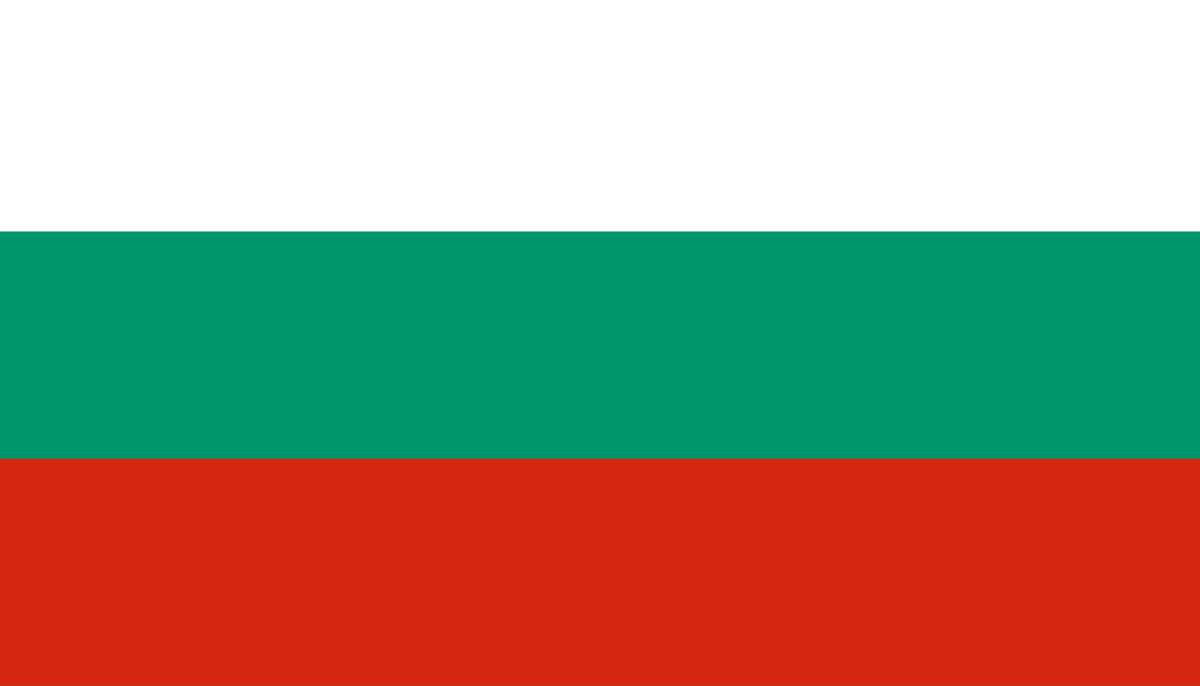
The official name of the state is the Republic of Bulgaria. The country covers an area of 111,030 km² (ranking 103rd in the world). Its population is approximately 6.67 million people (as of 2026).
Ethnic Bulgarians make up the majority of the population—about 85% of residents. Turks constitute the second-largest group, accounting for approximately 9% of the population; they live in concentrated communities in several regions in the east and south of the country. Roma make up about 5% of the population, with other nationalities accounting for less than 1%.
Religious composition: Orthodox Christians make up about 65% of the population (the majority belonging to the Bulgarian Orthodox Church). Muslims form the second-largest group, comprising approximately 10% of residents. Those who are non-religious or undecided account for about 25%.
The official language of Bulgaria is Bulgarian. It is the first—and currently the only—Cyrillic-based language recognized as one of the 23 official languages of the European Union. In addition to Bulgarian, the Turkish language is also widely spoken in several regions of the country.
The country's official currency is the Bulgarian lev.
Sofia is the capital and largest city of Bulgaria. It accounts for about one-sixth of the country's total industrial output (including sectors such as mechanical engineering, metallurgy, and the chemical, rubber, pulp and paper, food processing, and light industries).
Plovdiv is the country's second-largest industrial center after Sofia. It is a key hub for the agricultural region of the Upper Thracian Plain. The city is home to enterprises in light industry (cotton, silk, and garment manufacturing), mechanical engineering, the chemical industry, and non-ferrous metallurgy, as well as the country's only factory producing cigarette paper and filters. Since the early 1990s, some industrial enterprises have been under foreign ownership. The aircraft repair plant located in Plovdiv is one of the country's 11 strategic military-industrial enterprises. Plovdiv is one of Bulgaria's key transport hubs.
Varna is the country's third-largest city, a cultural and financial center, and a major transport hub. It is also Bulgaria's largest port, featuring ferry connections to Chornomorsk, Port Kavkaz, Poti, Batumi, and Istanbul.
Burgas is a key economic, transport, administrative, and cultural center in Southeastern Bulgaria. The Burgas Petrochemical Complex, built in the 1960s, is the largest industrial complex in Southeastern Europe. On March 15, 2007, an agreement was signed in Athens by the governments of Russia, Greece, and Bulgaria to construct the Novorossiysk–Burgas–Alexandroupolis oil pipeline. The city also hosts food processing, textile, and machinery manufacturing industries, and the fishing industry is well-developed. The Burgas region is home to resort areas (Sunny Beach, Nessebar) and the Burgas Mineral Baths balneological and mud-therapy resort.
Ruse is Bulgaria's largest city, industrial center, and port on the Danube River. A large two-level bridge (2,800 meters long) spanning the Danube is located near the city. It serves as the primary overland gateway for freight and passenger transport between Bulgaria and Romania, as well as between Bulgaria and Russia. In terms of machinery manufacturing—including agricultural machinery, shipbuilding, electronics, instrumentation, and heavy equipment—Ruse ranks alongside Plovdiv, trailing only Sofia. The city also has chemical, textile, and—notably—food and beverage processing industries. Ruse is the center of a region with well-developed viticulture and sugar beet farming.
Administratively, Bulgaria is divided into 28 provinces, which are subdivided into 265 municipalities.
The history of Bulgaria spans more than 1,300 years. Situated between Europe and Asia, the country has for centuries served as a crossroads for trade routes, cultures, and the interests of great powers. Powerful states emerged here, major wars were fought, and traditions were forged that influenced the entire Slavic world.
The first known inhabitants of the territory of modern-day Bulgaria were the Thracians, who settled the land as early as the 2nd millennium BC. They were skilled warriors, farmers, and master goldsmiths. It was in Bulgaria that the famous Thracian gold treasures—considered some of the oldest examples of the jeweler's art in the world—were discovered.
In the 1st century AD, these lands became part of the Roman Empire. The Romans built roads, fortresses, theaters, and cities here, many of which still exist today. Following the division of the Roman Empire in 395, the territory of Bulgaria came under the rule of the Eastern Roman Empire—Byzantium.
The year 681 marks the beginning of Bulgarian statehood. It was then that Khan Asparuh, leader of the Bulgars, defeated the Byzantine Emperor Constantine IV, and Byzantium recognized the establishment of the First Bulgarian Empire. Over time, the Bulgars merged with the Slavic tribes inhabiting the region, laying the foundation for the formation of the Bulgarian people.
The adoption of Christianity in 865 under Prince Boris I was a particularly significant event. This move strengthened the state and fostered its cultural development. It was in Bulgaria that the disciples of Cyril and Methodius were able to continue their work, facilitating the spread of the Cyrillic script, which subsequently became the writing system for many Slavic nations.
The First Bulgarian Empire reached its zenith under Tsar Simeon the Great, who reigned from 893 to 927. This period is known as the Golden Age of Bulgaria. The state significantly expanded its borders and became one of Europe's most powerful nations, while literature, architecture, and education flourished.
After Simeon's death, the country gradually weakened due to internal conflicts and wars with neighbors. In 1018, Bulgaria was conquered by Byzantium and remained under its rule for nearly two centuries.
A new era began in 1185, when the brothers Asen and Peter led an uprising against the Byzantines. This marked the emergence of the Second Bulgarian Empire, with its capital in Tarnovo. The state once again became a major political and cultural center in the Balkans. The reign of Tsar Ivan Asen II was particularly successful; under his rule, Bulgaria actively developed trade and diplomatic ties with European nations.
However, in the 14th century, Bulgaria faced a new threat: the Ottoman Empire. In 1396, the Bulgarian state lost its independence completely, and the country fell under Ottoman rule for nearly five centuries. Despite the loss of statehood, the Bulgarian people managed to preserve their Orthodox faith, language, and national traditions. The Bulgarian National Revival began in the 18th and 19th centuries, a period marked by the opening of schools, the flourishing of literature, and the emergence of an independence movement.
The April Uprising of 1876 was a pivotal moment in the struggle for freedom. Although it was suppressed, the brutality of the Ottoman authorities sparked a strong international reaction. The country's liberation became possible following the Russo-Turkish War of 1877–1878, during which Bulgarian volunteers fought alongside the Russian army for their homeland's independence.
Bulgaria gained autonomy in 1878, and in 1908, it officially proclaimed full independence and restored the kingdom. In the early 20th century, the country participated in the Balkan Wars and World War I, seeking to unite territories with Bulgarian populations; however, these conflicts resulted in heavy losses.
During World War II, Bulgaria initially aligned itself with the Axis powers but changed course in 1944, entering the war against Nazi Germany. The monarchy was abolished in 1946, and the country became a People's Republic under Soviet influence. Over the following decades, industry, agriculture, and the education system saw significant development, though political life remained under strict state control.
The communist regime fell in 1989, marking the beginning of Bulgaria's transition to democracy and a market economy. The country joined NATO in 2004 and became a member of the European Union in 2007.
Today, Bulgaria is a modern European republic with a rich historical heritage. It is renowned for its ancient monuments, Orthodox monasteries, Black Sea resorts, and a culture that blends Thracian, Slavic, Byzantine, and Ottoman traditions. Bulgaria holds a special place in the history of Slavic civilization, having played a pivotal role in the spread of the Cyrillic script and the development of Orthodox culture.
Bulgaria is located in Southeast Europe, on the Balkan Peninsula. It shares borders with Romania to the north, Serbia and North Macedonia to the west, and Greece and Turkey to the south. To the east, the country borders the Black Sea.
Bulgaria’s terrain is diverse: plains and hilly areas lie to the north, the Balkan Mountains run through the center, and the Rila, Pirin, and Rhodope mountain ranges are located in the south. The country's highest point is Mount Musala, at 2,925 meters.
Bulgaria has numerous rivers, most of which originate in the mountains. The country's main river is the Danube, which flows along the northern border with Romania; it plays a vital role in navigation, trade, and transport.
The country enjoys a strategic geographic location, with important transport routes crossing its territory to connect Central Europe with Turkey, Greece, and the Middle East. Access to the Black Sea is also crucial for trade, port infrastructure, and tourism.
Bulgarian culture has been shaped by Slavic, Balkan, Orthodox Christian, and European traditions. Bulgarians take pride in their history and cherish their cultural heritage, folk customs, music, dance, and national cuisine. Family, friendships, hospitality, and respect for tradition are highly valued. At the same time, modern Bulgaria blends a traditional Balkan lifestyle with a European way of life, particularly in major cities such as Sofia, Plovdiv, and Varna.
Folk festivals and rituals are an important part of the national culture. One of the most famous is *Baba Marta*, celebrated on March 1st; it involves the tradition of exchanging *martenitsas*—red-and-white ornaments that symbolize health and the arrival of spring. Traditions such as *Nestinarstvo* (a traditional ritual involving barefoot dancing on hot coals), folk music, and dance are also preserved and passed down from generation to generation.
Cultural heritage recognized by UNESCO holds a special place. The World Heritage List includes the Rila Monastery—one of the country's key spiritual centers—as well as the Boyana Church with its unique medieval frescoes, the ancient city of Nesebar on the Black Sea coast, the Madara Rider, the Thracian Tomb of Kazanlak, the Rock-Hewn Churches of Ivanovo, and Pirin National Park. These sites reflect Bulgaria's rich history and its significance as a cultural hub in the Balkans.
The Bulgarian mindset is often characterized as calm, sociable, and pragmatic. Trust, personal acquaintance, and a good reputation are important in relationships. Bulgarians value stability, family ties, and personal freedom, and social interactions typically take place in a fairly informal atmosphere. Traditional values are particularly evident in small towns and rural areas, whereas modern European attitudes toward work, education, and lifestyle are increasingly prevalent in major cities.
Bulgaria is a parliamentary republic.
The head of state is the President, elected by universal and direct suffrage for a five-year term.
The permanent supreme legislative body is the unicameral National Assembly (240 deputies), elected for a four-year term.
The executive body is the Council of Ministers, comprising the Prime Minister and the ministers.
The body responsible for constitutional oversight is the Constitutional Court of Bulgaria, which has the authority to strike down unconstitutional laws and provisions; its rulings are not subject to appeal.
The highest court of general jurisdiction is the Supreme Court of Cassation; the appellate courts serve as courts of second instance, regional courts act as courts of first instance, and district courts constitute the lowest tier of the judicial system. The Supreme Administrative Court adjudicates matters concerning subordinate legislation issued by all levels of state and local administration. The Supreme Judicial Council determines the composition of the judiciary, the public prosecutor's office, and investigative bodies in Bulgaria.
Bulgaria is an open European economy that is closely integrated into the EU single market (having joined the eurozone on January 1, 2026).
The service sector is the largest part of the country's economy. It encompasses trade, transport, financial services, real estate, tourism, telecommunications, education, healthcare, and information technology. IT, software development, and business process outsourcing are experiencing particularly rapid growth. Sofia, the country's capital, serves as the main business and financial hub, hosting a significant concentration of technology and service companies.
Industry plays a vital role in the economy, catering to both domestic and export markets. Key sectors include mechanical engineering, the manufacture of electrical equipment and electronic components, the automotive industry, metallurgy, and the chemical and pharmaceutical industries. The country is home to enterprises producing automotive parts, electrical equipment, industrial machinery, and various types of finished goods. Bulgarian industry is closely linked to the production chains of other EU nations.
The energy sector is of strategic importance to the country. Bulgaria relies on nuclear, thermal, and hydroelectric power plants while actively developing solar and other renewable energy sources. The Kozloduy Nuclear Power Plant is a key source of electricity. Its geographical location also enables Bulgaria to participate in regional electricity trade and the development of energy infrastructure across the Balkans.
Agriculture remains a significant sector, particularly in regions outside major cities. Bulgaria produces wheat, corn, sunflowers, and other cereal crops, alongside fruits and vegetables. Viticulture, winemaking, and the cultivation of oil-bearing roses are also major activities. Livestock farming and dairy production are well-developed as well. Agricultural products are supplied to both domestic and export markets.
Tourism is one of the most significant sources of revenue within the service sector. Bulgaria offers a blend of seaside and mountain resorts, historic cities, and cultural attractions. In summer, the main flow of tourists is drawn to the Black Sea coast, while winter sees the development of ski resorts. There is also growing interest in cultural, wellness, and eco-tourism.
The transport and logistics sectors are developing thanks to Bulgaria's geographic location. The country sits at the crossroads of European transport routes connecting Central Europe with Turkey, Greece, and other countries in the region. The ports of Varna and Burgas, road and rail corridors, and the Danube River play vital roles. This creates opportunities for the development of warehouse logistics, transit transport, and international trade.
Construction and real estate are also significant economic sectors. Residential and commercial construction, hotel infrastructure, and transport facilities are all expanding. Construction activity is concentrated primarily in Sofia, major cities, and tourist regions.
Bulgaria's foreign trade is largely oriented toward the European Union. Key trading partners include Germany, Romania, Italy, Greece, and France. The country exports electrical and electronic equipment, machinery and components, metals, chemical and pharmaceutical products, agricultural goods, food products, and textiles. Imports consist of machinery and equipment, electronics, vehicles and components, energy resources, chemical products, and various industrial goods.
Overall, Bulgaria’s economy has a diversified structure: services account for the largest share, industry provides significant export potential, and agriculture, energy, tourism, and transport complement the economic system. EU membership grants the country access to the European Single Market and serves as a key factor in its economic development.
Relations with Russia
The primary mechanism for state-level trade and economic cooperation between Russia and Bulgaria is the Intergovernmental Russian-Bulgarian Commission on Economic and Scientific-Technical Cooperation. Trade and economic ties encompass the mutual exchange of industrial and consumer goods, cooperation in the energy and industrial sectors, and the operations of Russian companies within the Bulgarian market.
Russia remains a significant foreign trade partner for Bulgaria. According to data from Bulgaria’s National Statistical Institute, Bulgarian exports to Russia totaled approximately €246.4 million in the first half of 2026—a 22.2% increase compared to the same period in 2025. Imports from Russia during this period amounted to approximately €119.1 million.
Bulgaria’s exports to Russia include electrical equipment, pharmaceutical and chemical products, foodstuffs, and various types of industrial goods and machinery. Russian exports to Bulgaria comprise products from the energy and chemical sectors, metals, raw materials, and other commodities.
The Lukoil Group remains one of the most prominent Russian companies operating in Bulgaria. Its corporate structure includes Lukoil Neftohim Burgas, Lukoil-Bulgaria, Lukoil Aviation Bulgaria, and Lukoil Bunker Bulgaria. Key business activities include oil refining, the storage and sale of petroleum products, and the supply of fuel for the aviation and shipping industries. In August 2026, the UK regulator extended the licensing regime allowing operations to continue with these four Bulgarian subsidiaries of the group until October 29, 2026. In 2026, LUKOIL Neftohim Burgas continues operations and supplies petroleum products to the Bulgarian market. According to the company, the facility’s oil processing volume reached 560,000 tons in July 2026, with feedstock supplies secured through the end of September and subsequent volumes already being planned.
A Russian presence is also maintained in the nuclear energy sector. One of the key Russian enterprises in this field is TVEL JSC, part of the Rosatom group. The company supplies nuclear fuel to the Kozloduy Nuclear Power Plant, with cooperation centered on the operation of Russian reactor technologies. This area remains one of the most technologically significant components of Russian-Bulgarian economic ties.
Furthermore, Russian companies maintain a presence in Bulgaria across various sectors, including industry, transport, energy, and trade. Prominent Russian groups include LUKOIL, Rosatom, and enterprises linked to nuclear energy and equipment supply; their activities constitute a significant portion of the Russian corporate presence on the Bulgarian market.
A concrete example of ongoing commercial interaction in 2026 is the procurement and service activity of LUKOIL-Bulgaria. Specifically, the company has conducted tenders for facility maintenance, fuel quality and quantity control, transformer substation maintenance, and electrical testing services covering the 2026–2027 period.
Thus, Russian-Bulgarian trade and economic relations retain a practical foundation in 2026. LUKOIL and Rosatom-affiliated entities stand out among the key Russian business players, while energy, oil refining, the fuel sector, the nuclear industry, chemicals, pharmaceuticals, metals, and industrial products remain the primary areas of cooperation. At the same time, cooperation is developing primarily through existing commercial ties, supplies, service agreements, and the operations of Russian companies on the Bulgarian market.
Bulgaria’s business climate is characterized by a mix of relatively favorable conditions for doing business and challenges related to the further modernization of the business environment. The country’s integration into the European economic area is a key advantage; however, the quality of public administration, the availability of personnel, and the speed of regulatory procedures remain crucial for companies. The OECD notes that Bulgaria’s competitive environment generally aligns with the organization's average, while further regulatory simplification could enhance the economy's appeal to business.
Administrative burden remains a primary concern for businesses. While company registration, permit acquisition, and interactions with government agencies are gradually shifting to digital formats, some procedures still require significant time and additional steps. In 2026, the Bulgarian government has specifically focused on reducing administrative requirements and improving the interaction between state authorities and entrepreneurs.
The labor market is of great importance to companies. Unemployment remains low, and the demand for staff stays high. At the same time, entrepreneurs face a shortage of skilled professionals, particularly in technical, manufacturing, and digital roles. According to a survey of Bulgarian businesses conducted as part of the 2026 European Economic Survey, rising labor costs and a lack of skilled workers are the most significant challenges facing companies.
Digitalization is emerging as a distinct factor in the development of the business environment. For Bulgaria, expanding the use of digital technologies is viewed as a way to boost corporate productivity and cut administrative costs. Significant potential lies in the adoption of software, automation, and artificial intelligence tools within small and medium-sized enterprises (SMEs).
Access to finance and conditions for business growth are also vital for entrepreneurs. Bulgarian businesses actively utilize bank lending, European financial instruments, and support programs. However, the cost of financing and capital availability remain key factors that companies consider when planning investments.
The development of small and medium-sized enterprises is a key feature of the business climate. It is precisely this segment that accounts for a significant share of business activity, employment, and services. For export-oriented companies, an additional advantage is the opportunity to integrate into European production and logistics chains.
Bulgaria maintains an attractive investment climate thanks to its European Union membership, strategic location in the Balkans, and relatively low tax burden. The country serves as an ideal base for companies seeking to operate in the Bulgarian market while simultaneously accessing the European Single Market.
The tax system is a key advantage. The corporate tax rate is 10%, and the standard VAT rate is 20%. Dividends paid to non-residents are taxed at a rate of 5% in cases stipulated by law. The low corporate tax rate makes Bulgaria one of the most competitive EU jurisdictions regarding the tax burden on business.
The adoption of the euro has been a significant factor in the country's investment appeal in 2026. Bulgaria switched to the euro on January 1, 2026. This simplifies transactions with European partners, reduces currency-related costs, and facilitates company access to euro-denominated financing. For foreign investors, the shift to the single currency also enhances the predictability of financial operations.
The country's geographical location is of great importance. Situated between Central Europe, Turkey, and the Balkans, Bulgaria has access to the Black Sea and boasts the ports of Varna and Burgas. This creates opportunities for investment in logistics, transport, warehousing infrastructure, and export-oriented manufacturing.
The state actively supports foreign investors through the Invest Bulgaria Agency. The agency provides market information, assists with the implementation of investment projects, and facilitates interaction with municipalities, industrial zones, and regional authorities. In 2026, priority is being given to projects that offer high added value and long-term economic impact, create jobs, and foster regional development. The most promising areas for investment include IT and business services, automotive components, electronics, mechanical engineering, pharmaceuticals, energy, logistics, food production, tourism, and real estate. The development of industrial infrastructure and the utilization of European funding create additional opportunities.
The investment climate is also supported by relatively stable macroeconomic indicators. The European Commission forecasts Bulgaria’s GDP growth at 2.5% in 2026, with the unemployment rate estimated at approximately 3.7%. Public debt remains comparatively low, projected at around 32.3% of GDP in 2026.
At the same time, investors must take regulatory specifics into account. Certain foreign investments are subject to a preliminary screening procedure, particularly in strategic sectors such as energy, transport, the financial sector, defense, telecommunications, critical technologies, and infrastructure.
Overall, Bulgaria is an attractive destination for investors. Projects focused on manufacturing, exports, technology, logistics, and high-value-added services appear the most appealing. However, the success of an investment project depends largely on the choice of region, the quality of infrastructure, and the availability of a skilled workforce. The European Commission specifically highlights the persistent skills gap and the need to further improve the quality of education and workforce training.
Bulgaria operates a system of state and financial institutions that support investment projects, the development of small and medium-sized enterprises (SMEs), innovation, and the expansion of companies into foreign markets.
- Invest Bulgaria Agency (IBA) — a state agency under the Ministry of Innovation and Growth. The agency supports investors at various project stages: it provides market and regional information, assists in selecting sites and infrastructure, facilitates interaction with state and local authorities, and offers advice on permits, incentives, and available financing. In 2026, a key priority for the IBA remains attracting projects with high added value and long-term economic impact. A specific area of the IBA’s work involves the certification of investment projects. Class A and Class B projects, as well as priority investment projects, may receive specific financial and administrative incentives under the Investment Promotion Act. These include assistance with administrative procedures, land acquisition, infrastructure preparation, staff training, and certain social expenses.
- Bulgarian Small and Medium-sized Enterprises Promotion Agency (BSMEPA). It provides entrepreneurs with information, consulting, and educational support, helping companies enter foreign markets, participate in international trade fairs and trade missions, and find international partners. In 2026, the agency is implementing programs aimed, among other things, at expanding Bulgarian companies' access to capital and international markets.
- Fund of Funds (Fund Manager of Financial Instruments in Bulgaria). It manages state and European resources, channeling them through various financial instruments to foster entrepreneurship, support investment projects, and enhance company competitiveness.
Industrial zones, municipalities, and regional bodies also play a supplementary role.
IBA collaborates with them to select sites for investors and assess infrastructure and workforce availability. In 2026, the agency is also developing an interactive investment map showcasing available industrial sites, infrastructure facilities, and regional human resource data.
European Union programs play a significant role. Under the 2021–2027 Programme for the Competitiveness and Innovation of Enterprises, businesses can receive support for technological upgrades, innovation adoption, digitalization, and the transition to more sustainable production models. Specific programs focus on research, digital technologies, and collaboration between businesses and scientific organizations.
The National Innovation Fund (NIF) operates for innovative companies. It funds research and development, the creation of new products and technologies, and collaborative projects between businesses and scientific organizations. In 2026, the fund is expanding support for projects spanning stages from development and technology validation to demonstration and practical application.
International innovation cooperation is a key area. For instance, through the Eurostars program, innovative Bulgarian companies can participate in international projects alongside enterprises, universities, and research organizations from other countries.
Industrial and technology zones provide additional infrastructure for investors. They offer ready-to-use sites, utility infrastructure, and facilities for locating manufacturing plants. Government bodies collaborate with municipalities and industrial zone operators to attract regional investment and establish new manufacturing hubs.
Funding for the green and digital transition remains a distinct priority. Bulgaria’s economic transformation program provides support to small and medium-sized enterprises through grants and financial instruments covering technological modernization, digitalization, renewable energy, energy efficiency, and the circular economy. The total volume of the program is approximately €735 million.
Thus, an entrepreneur in Bulgaria can turn to various entities depending on their specific needs: IBA for investment support; BSMEPA for business development and entering foreign markets; the Fund of Funds for financial instruments; the National Innovation Fund for innovation projects; and EU programs for business modernization, digitalization, and green transformation. This creates a multi-level support system aimed at both local companies and foreign investors.
18,751,241 ¥


Want to convert the amount into another currency at the rate? On the catalog pages, at the bottom right, there is a button with currency icons, it opens a calculator. Our website has more than 20 currencies with daily recalculation of the rate.

