


The New Geography of Russian Export-Import Operations: The Scale of Economic Presence in the Markets of the East and the Global South
 Table of contents
- Geoeconomic Redistribution of Russia's Exports and Imports for 2020-2025
- Russia's Export-Import Operations in Southeast Asian Markets in 2024-2025
- Structure of Russia's Export-Import Operations in Africa, BRICS, and Latin America in 2024-2025
- Structural Barriers to Diversifying Non-Commodity Exports in Foreign Economic Activity

The expert opinion was prepared following the results of the WEF-2025 session "Foreign Economic Activity - 2030. New Horizons of International Trade."
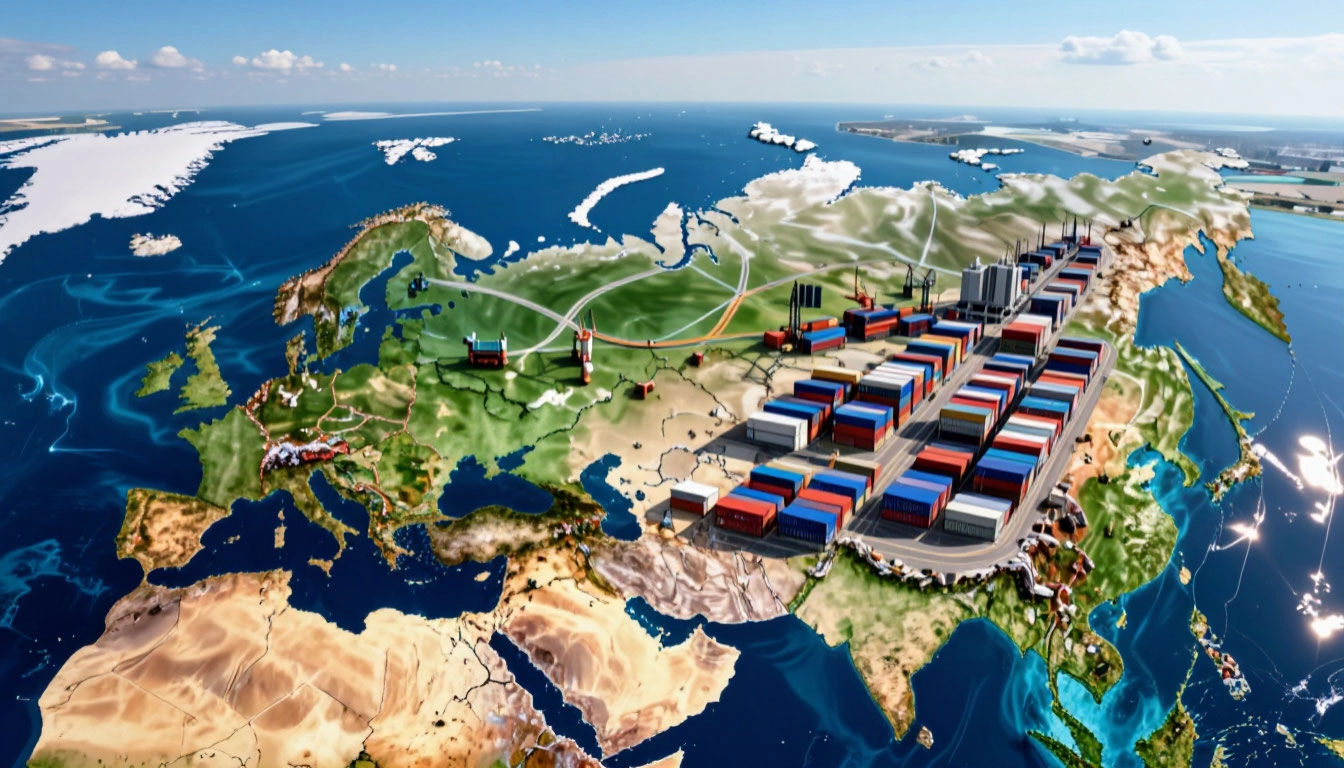
Geoeconomic Redistribution of Russia's Exports and Imports for 2020-2025
Over the past five years, Russia has undergone significant changes in the geoeconomic landscape of its foreign trade, driven by both external political and economic factors and internal challenges, including the COVID-19 pandemic and sanctions. One of the key factors influencing export flows has been a reduction in dependence on Western countries and a shift toward expanding trade relations with countries in Southeast Asia, Africa, Latin America, and the BRICS countries. Spatial shifts in the commodity structure of Russia's exports include an increase in the share of exports to countries in the Asia-Pacific region and a decrease in the share of exports to European Union countries. The sanctions imposed on Russia have put pressure on trade relations between the European Union and Russia. Furthermore, the effects of the COVID-19 pandemic have exacerbated the situation, reducing Russia's exports to European countries. The share of Russia's exports to the European Union decreased from 37.4% in 2020 to 22.1% in 2024 of total exports, while the share of exports to the Asia-Pacific region increased, reaching 33.8%. The share of Russia's exports to the BRICS countries increased to 25.4%, and the share of exports to Latin American countries to 5.5%, respectively. As a result of existing restrictions for Russian goods in the EU markets, the share of Russia's natural gas exports decreased (from 36% in 2020 to 18% in 2024), the share of coal exports (from 45% in 2020 to 13% in 2024), the share of oil exports (from 25% in 2020 to 14% in 2024), and the share of steel and iron exports (from 16% in 2020 to 5% in 2024). Spatial shifts are also observed in the geographic structure of Russia's imports: an increased focus on strengthening trade ties with countries in the Asia-Pacific region and weakening trade ties with EU countries. The share of Russia's imports from EU countries fell to 33% in 2024, while the share of imports from Asia-Pacific countries increased to 43.6% in 2024. The share of imports from Africa, Asia-Pacific countries, BRICS countries, and Latin America increased to 3.1%, 43.6%, 30.8%, and 6.2%, respectively. The commodity structure of Russia's imports from the European Union has also undergone changes: the share of machinery and transport equipment decreased (from 43.9% in 2020 to 29.1% in 2024). Thus, against the backdrop of weakening trade relations between Russia and the European Union, alternative routes for goods exchange with other regions of the world are emerging.
Russia's Export-Import Operations in Southeast Asian Markets in 2024-2025
Russia's foreign trade relations with Southeast Asian countries are undergoing significant structural transformation. The historically commodity-based model that dominates Russian exports will be deliberately modified to focus on diversification starting in 2024. Key vectors of this policy include increasing supplies of agricultural products, mechanical engineering, and highly processed goods. At the same time, the share of high-tech products in Russia's imports from Southeast Asia is steadily increasing, which has a complex impact on bilateral economic ties. In 2024-2025, Russia's position in Southeast Asian markets will consolidate, driven by structural shifts toward export diversification. A key trend is the growing importance of the non-commodity sector, particularly mechanical engineering, chemical, electronic, and agricultural products. Countries such as China, Vietnam, Thailand, and Indonesia are the main trading partners in this area. According to the Russian Ministry of Economic Development, high-tech exports, including communications equipment, control systems, and robotics, to the region increased by 16.7% from 2020 to 2024, reaching $3.5 billion. The largest increase in demand for these products was observed in Vietnam and Thailand. At the same time, according to the Russian Ministry of Agriculture, agricultural exports (grain, meat, and fish) increased by 12%, reaching approximately $6.7 billion. This growth is due to the region's growing food needs and the commitment of Southeast Asian countries to diversify their imports, with Vietnam and Indonesia being the largest recipients of Russian grain and fish.
Imports from Southeast Asian countries to Russia are also showing positive dynamics, with a shift in structure toward non-resource components. According to data from the Federal Customs Service of the Russian Federation, the share of finished goods and high-tech products in total imports reached 45% in 2024, an increase of 6.3 percentage points compared to 2020. In 2024, Russia's imports of high-tech products, particularly electronic components, computing equipment, and engineering products, are expected to grow significantly. China, the key supplier, accounted for 21.5% of all imports from Asia-Pacific countries, amounting to approximately $7.3 billion in absolute terms. The dominance of Chinese supplies, covering the consumer electronics and industrial components segments, creates a persistent dependence on Asian high-tech markets. This trend creates potential risks for the sustainability of production chains and the availability of critical components for domestic industry. Consumer goods account for a significant share of imports from Southeast Asian countries. According to Rosstat, household goods (clothing, footwear, textiles, and hygiene products) accounted for 8.1% of total imports in 2024. The growth in supplies from Vietnam, Indonesia, and Thailand reflects the active development of export-oriented industries in these countries, with Russia as the target market.
Structure of Russia's Export-Import Operations in Africa, BRICS, and Latin America in 2024-2025
In 2024, Russian exports to African countries will significantly increase, characterized by a diversified product mix. Non-commodity products accounted for approximately 45% of total supplies, with a focus on mechanical engineering (energy and mining equipment), agricultural goods, and military-technical products. In particular, agricultural exports (grain and fish) reached $1.1 billion, representing a 14% increase compared to 2020. The commodity structure of Russian exports to the BRICS countries has undergone a significant transformation, reflected in the growth of non-resource sector deliveries. In 2024, mechanical engineering exports to China and India increased by 20%, reaching $2.9 billion. Trade with India has demonstrated particular growth, with a significant increase in medical equipment, pharmaceuticals, and light industry goods. Exports to Latin America, particularly Brazil and Argentina, have also undergone changes, with an emphasis on agricultural goods and high-tech products. In 2024, Russia increased its exports of agricultural products (grain and meat) by 18%, reaching $2.3 billion. Concurrently, high-tech exports, including machinery and equipment, amounted to $1.7 billion, a 12% increase compared to 2020. A simultaneous increase in Russian imports from key macro-regions—Africa, BRICS, and Latin America—is also observed. In 2024, significant growth was seen in machinery and equipment shipments from China and India (17%), as well as consumer and chemical goods from Latin American countries. This trend toward diversifying import flows is projected to continue into 2025.
Structural Barriers to Diversifying Non-Commodity Exports in Foreign Economic Activity
Realizing the export and import potential in these regions is a key focus of Russia's foreign economic strategy. However, expanding its presence in these markets is constrained by a number of structural barriers of an institutional, technological, and infrastructural nature.
Despite the progress achieved in export diversification, as evidenced by the growth in the share of non-commodity goods in exports to Asian and African countries to 48.3%, further expansion of Russian producers into Eastern and Global South markets faces a complex set of systemic barriers.
- Institutional and Legal Barriers. Russia's integration into preferential trade regimes with developing countries remains limited: only 36% of agreements provide for preferential terms, while in OECD countries this figure exceeds 70%. The lack of a developed network of agreements on mutual recognition of standards and certification results creates additional administrative barriers to market entry, particularly for high-tech products and services. For example, according to Irina Malamant, CEO of Neurosoft LLC, when entering markets in countries such as China, India, and Indonesia, the company faces sovereignty issues in these countries, which manifest themselves in relatively high duties for importers and preferences for domestic manufacturers. Therefore, their primary goal is to localize production.
- Production and technological challenges. The competitiveness of non-resource exports is undermined by continued dependence on critical component imports and the low localization depth of production chains. This limits the capabilities of Russian companies in industries dominated by technology leaders such as China, India, and South Korea (electronics, pharmaceuticals, mechanical engineering).
- Logistics and financial constraints. The operating environment is characterized by rising costs: export costs to Southeast Asian countries increased by 14.6% compared to 2022. This dynamic is exacerbated by limited diversification of transport corridors, sanctions risks, and limited access to international trade finance and insurance instruments. In his speech at the EEF 2025, Alexander Iodchin, First Deputy General Director for Strategy and Development at Delo Group, emphasized that Russia must integrate into all stages of the supply chain, offering exporters door-to-door services to reduce dependence on foreign carriers, as well as building infrastructure abroad to control the entire supply chain.
- Infrastructure and personnel shortages. The efficiency of foreign trade operations is reduced by the underdevelopment of export infrastructure, including logistics hubs and digital platforms. A key constraint remains the acute shortage of qualified personnel in international marketing and foreign economic activity, noted by only 32% of Russian enterprises. These limitations were mentioned during the EEF 2025 session "Foreign Economic Activity 2030. New Horizons of International Trade." As Alexander Vaino, Director of the Young Professionals Division at the Agency for Strategic Initiatives for the Promotion of New Projects (ASI), noted, Russia faces the challenge of not only training foreign trade specialists but also developing potential import and export country master plans—that is, new methodologies for the operation of a single export-import window.

Tags:
 Telegram
 VK.com
 Facebook
 X (Twitter)
 LinkedIn
 Other topics:
 REAB Services
Initial business valuation
Business analysis and audit (Due Diligence)
Business pre-sale preparation
Initial assessment of the business being purchased
Audit of the purchased business (Due Diligence)
Company Registration — General Provisions

 News
News
 Useful tip
Subject tags are a convenient and quick way to find all the information on this website related to a certain topic. Such tags are under each article, news item, description of a service or country, and all the lots in the catalog.

